
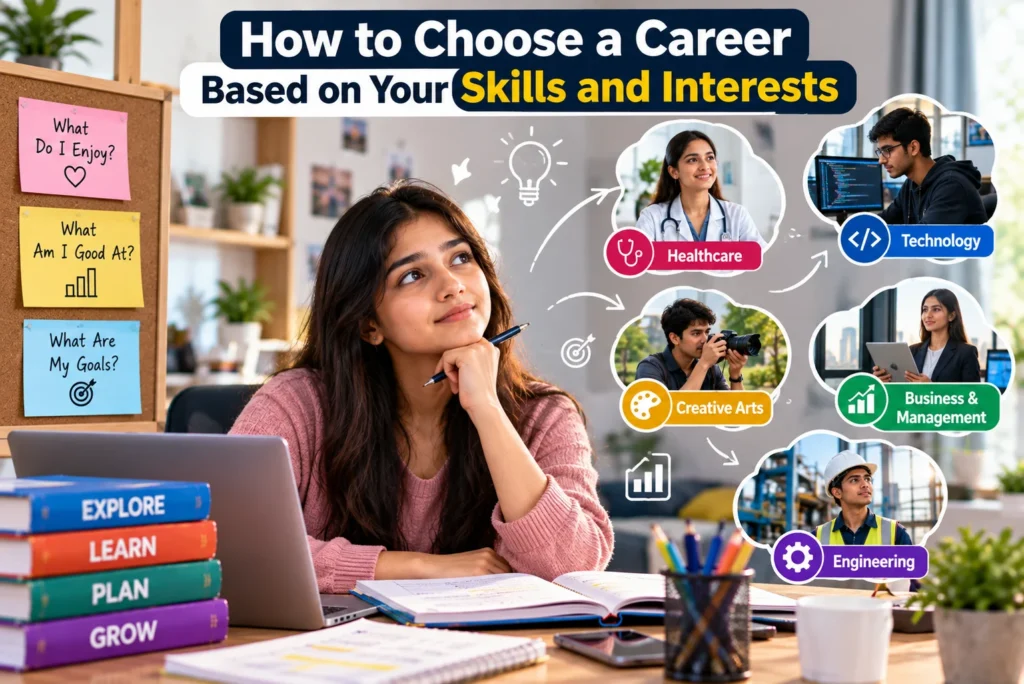
Ask successful professionals how they found their careers, and many will describe a moment when what they enjoyed and what they were good at came together. A designer who loved drawing and noticed details, an accountant who enjoyed numbers and order, a teacher who liked explaining ideas and helping others. When you choose a career based on skills and interests, you give yourself the best chance of finding work that feels meaningful and that you can sustain over decades. Salary, status and family expectations matter, but they work best when they sit on top of a real fit between you and the work.
This guide by vidyanirbhar is for students in Classes 11 and 12, recent graduates and parents. We explain how to identify the skills and interests that matter for careers, how to connect them to career families, how to test the fit through real experience, and how to balance personal fit with practical concerns. We use the National Institute of Fashion Technology as a real example of an institution whose programmes are built around specific creative and technical skills, showing how a clear skill and interest profile can point to a focused career path.
Skills, Interests and Values: The Three Pillars
| Pillar | What It Means | Examples |
|---|---|---|
| Skills | What you can do well, through talent or practice | Numerical reasoning, writing, drawing, speaking, coding, organising, building things |
| Interests | What you enjoy and are curious about | Technology, people, business, nature, art, health, society, sport |
| Values | What matters most to you in work | Stability, income, creativity, independence, helping others, prestige, work life balance |
A good career fit usually satisfies all three. Skills make the work manageable, interests make it enjoyable, and values make it meaningful. A career that matches skills and interests but conflicts with your values, for example a high pressure role for someone who values balance, can still feel wrong after a few years, even if it looks good on paper.
Step 1: Identify Your Career Relevant Skills
Career relevant skills go beyond school subjects. Consider:
- Cognitive skills: analysis, problem solving, memory, attention to detail.
- Communication skills: writing, speaking, listening, persuading, explaining.
- Creative skills: visual design, storytelling, music, generating new ideas.
- Technical skills: programming, using tools and software, working with machines.
- People skills: teamwork, leadership, empathy, negotiation.
- Organisational skills: planning, managing time, coordinating events or projects.
Look for evidence in your marks, school projects, clubs, competitions, part time work, volunteering and feedback from teachers and friends.
Step 2: Identify Your Lasting Interests
Interests that last for years are better guides than sudden enthusiasms. Think about the topics you keep returning to, the news stories you read without being asked and the activities you choose in free time. Many career counsellors group interests into broad types, such as practical, investigative, artistic, social, enterprising and organised. You might recognise yourself in one or two of these. Use them as a starting point for thinking about careers rather than as fixed labels, because most people show a mix of types.
Step 3: Connect Your Profile to Career Families
| Profile | Career Families Worth Considering |
|---|---|
| Analytical and investigative | Research, data science, engineering, medicine, economics, finance |
| Creative and artistic | Design, fashion, architecture, media, writing, film, advertising |
| Social and helping | Teaching, counselling, healthcare, social work, human resources |
| Enterprising and persuasive | Business, sales, marketing, law, entrepreneurship, politics and public service |
| Practical and technical | Engineering, technical trades, aviation, hospitality operations, agriculture |
| Organised and detail oriented | Accounting, banking, administration, logistics, compliance |
Most people combine two or more profiles. A student who is creative and analytical might consider architecture or user experience design. A student who is social and enterprising might consider human resources, marketing or law.
Real Example: NIFT and Skill Based Career Paths
The National Institute of Fashion Technology was set up in 1986 under the Ministry of Textiles and became a statutory institute under the NIFT Act, 2006, which empowers it to award degrees. It runs campuses in several Indian cities and offers undergraduate programmes in design specialisations and in fashion technology, along with postgraduate programmes. Admission is through its own entrance process, which tests creative ability, general aptitude and, for some programmes, situation based or interview rounds. Details for each year are published on the NIFT website.
NIFT is a useful example because its programmes are built around clear skill and interest profiles. Design programmes suit students with visual creativity, observation and an interest in fashion, textiles or accessories. Fashion technology suits students with technical and analytical skills and an interest in manufacturing and production. Fashion management related programmes at the postgraduate level suit students with business and organisational strengths. The lesson is that once you know your profile, you can often find institutions and programmes that match it closely.
Step 4: Test the Fit Through Experience
Reading and reflection only go so far. Before committing to a career, test it:
- Do a short internship, job shadowing day or volunteer role in the field.
- Complete a small project, such as a design portfolio, a coding app, a business plan or a research report.
- Take a short online course on a recognised platform such as SWAYAM.
- Talk to two or three professionals about their daily work.
After each experience, ask yourself: did I enjoy this, did I do it reasonably well, and would I want to do more of it? Honest answers are worth more than any test result or advice from others.
Step 5: Balance Fit With Practical Realities
Personal fit is the foundation, but practical factors also matter. Consider:
- Route: which degree, entrance exam and qualifications the career needs.
- Cost: fees and living costs for the training required.
- Opportunities: demand for the role in the regions where you want to work.
- Time: how long it takes to become qualified and earn steadily.
- Family circumstances: responsibilities, financial needs and location preferences.
If a career you love has limited openings, build complementary skills that widen your options. A literature graduate who adds digital marketing skills, or a BA graduate who adds data skills, can reach a wider range of roles.
An Illustrative Profile
Consider a student who enjoys sketching, notices small details in clothes and objects, scores moderately in Mathematics, communicates well and values creativity over stability. This profile points towards creative careers such as fashion or product design, with communication helping in client facing roles. To test it, the student could build a small portfolio, attend a design workshop and speak to a working designer. If the interest holds, design entrance tests become the next step. If the student also wants a fallback, a short certificate course in a related skill, such as digital illustration, can add value without a large commitment. This is an illustration, not a real case, but it shows how the steps fit together.
Talking to Parents About Your Choice
Parents may worry about careers they know less about, especially creative or newer fields. Share what you have learned: the training route, institutions, costs, typical roles and the experiences that confirmed your interest. Invite them to meet a professional in the field with you. When families see a thoughtful plan with clear steps and a backup, they are usually more supportive.
Using Aptitude and Interest Assessments Wisely
Aptitude and interest assessments can be helpful when used properly. They give a structured view of your strengths and preferences and may suggest careers you had not considered. Their limits are that they capture a moment in time, depend on honest answers and cannot account for your circumstances. Take them through a qualified counsellor where possible, and discuss the results alongside your marks, experiences and goals.
When Skills and Interests Point in Different Directions
Sometimes you are skilled at something you do not enjoy, or love something you are not yet good at. Ask whether the skill gap can close with practice, since many skills grow with effort when interest is real. Look for careers that combine both, such as a student good at mathematics but interested in society choosing economics or public policy. Remember that lasting interest is harder to create than skill.
Revisiting Your Choice Over Time
Your skills and interests will grow and change through college and work. Revisit your career choice every year or two, ideally after each major experience such as an internship. Notice which tasks energise you and which drain you. Many people adjust their direction within a field, such as moving from engineering into product management, or from accounting into financial analysis. This is a normal and healthy part of career growth.
Common Mistakes Students Make
- Choosing careers based only on salary or status
- Confusing a short term interest with a lasting one
- Ignoring personal values when choosing a career
- Relying on a single aptitude test result
- Not testing a career through real experience before committing
- Assuming skills cannot grow with practice
Conclusion
When you choose a career based on skills and interests, and check it against your values and practical realities, you build a strong foundation for long term satisfaction. Identify your profile, connect it to career families, test the fit through experience and revisit your choices as you grow. NIFT shows how clear skill and interest profiles can lead to well matched programmes and careers. Vidyanirbhar prepares these guides so that students find careers that truly suit them. You can compare courses and institutions that match your strengths on VidyaNirbhar as you plan.
Frequently asked questions
How do I choose a career based on my skills and interests?
List your skills with evidence, identify lasting interests and clarify your values. Connect your profile to career families, test the best options through internships, projects or conversations with professionals, and then check practical factors such as route, cost and opportunities before deciding.
What if my interests do not match my skills?
Ask whether the skill gap can close with practice, since many skills grow with effort when interest is genuine. Look for careers that combine both areas. If interest is weak in a field where you are skilled, think carefully before committing for the long term.
Are career aptitude tests reliable?
They can offer useful insights into strengths and preferences, but they are not definitive. Results depend on honest answers and capture one moment in time. Use them with a qualified counsellor and combine them with your marks, experiences and goals.
Which careers suit creative students?
Creative students can consider design, fashion, architecture, media, advertising, writing, film, animation and user experience design. Many of these have entrance tests that assess creative ability, so building a portfolio and practising creative skills during school is helpful for admission.
Can I change careers later if my interests change?
Yes. Many people change direction successfully through postgraduate study, professional courses or skill programmes. Transferable skills such as writing, communication, analysis and problem solving make changes easier. Revisit your choices regularly and build skills that stay useful across many fields.