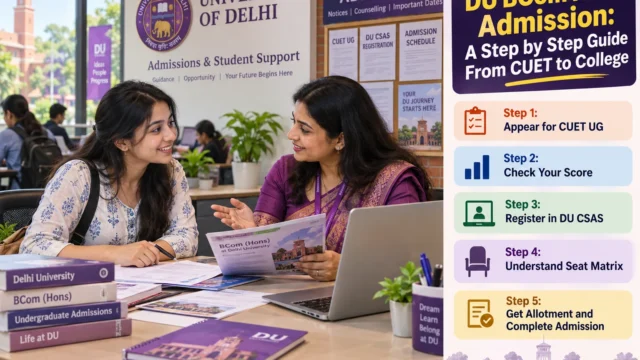
The University of Delhi attracts lakhs of applicants every year for its undergraduate programmes, spread across dozens of colleges in the city. Since 2022, the route into DU has changed completely: the old cut off lists based on Class 12 marks have been replaced by admissions based on the Common University Entrance Test (CUET UG) and DU’s own Common Seat Allocation System (CSAS). Students who understand how to get admission in DU, from choosing CUET subjects to accepting an allotted seat, give themselves a far better chance than those who learn the process only after results.
This guide by vidyanirbhar is for Class 11 and 12 students, their parents and anyone planning to apply to DU for undergraduate study. We explain eligibility, how to choose CUET subjects for DU programmes, the phases of the CSAS process, how seats are allocated and upgraded, documents and fees, and common mistakes. We use Miranda House, one of DU’s well known women’s colleges, as a real example of how a college fits into the centralised DU admission system.
Step 1: Understand the Two Stage Process
| Stage | Conducted By | What You Do |
|---|---|---|
| CUET UG | National Testing Agency | Register, choose languages and domain subjects, appear for the test |
| CSAS UG | University of Delhi | Register on DU’s portal, fill programme and college preferences, accept allocated seats, pay fees |
Both stages are compulsory. A good CUET score alone does not give you a DU seat unless you also complete CSAS registration and preference filling on time.
Step 2: Check Programme Eligibility
Each DU programme has its own eligibility, usually based on Class 12 subjects and the CUET subjects you take. For example:
- BA honours programmes in subjects such as History or Political Science usually require a language and relevant domain subjects or the general test, as specified in the bulletin.
- BCom and BCom honours often require Mathematics or Accountancy in specific combinations.
- BSc programmes require relevant science subjects such as Physics, Chemistry, Mathematics or Biology.
- Programmes such as BA honours Economics often require Mathematics in Class 12 and in CUET.
Read DU’s undergraduate information bulletin for the current year carefully, since programme-wise CUET subject combinations are listed there.
Step 3: Choose CUET Subjects Strategically
Your CUET subject choices decide which DU programmes you are eligible for. Before filling the CUET form:
- List the DU programmes you might want.
- Check the subject combination required for each in the DU bulletin.
- Choose CUET languages, domain subjects and, if needed, the general test that cover as many target programmes as possible.
- Prefer domain subjects you studied in Class 12, since the syllabus is aligned with it.
A wrong subject choice in CUET can make you ineligible for a programme you wanted, even with high scores in other subjects.
Step 4: Register on CSAS
DU usually opens CSAS UG registration on its admission portal before CUET results. The process typically has phases:
- Phase 1: registration, personal and academic details, document uploads and fee payment.
- Phase 2: after CUET results, filling programme and college preferences in order.
- Seat allocation rounds: DU allots seats based on CUET scores, preferences, category and seat availability.
In the 2025 cycle, for example, DU ran CSAS registration and choice filling on its admission portal, used Class 10 marks among tie breakers for equal scores, and published the first seat allocation in July with a short window to accept seats. The admission portal for the current year is available at the DU admission portal.
Step 5: Fill Preferences Carefully
Preference filling is the most important strategic step. Combinations of programme and college are listed, and you arrange them in order of preference. Tips:
- Fill as many realistic preferences as you would actually accept.
- Rank combinations in true order of preference, not by guesses about cut offs.
- Consider both the programme and the college: teaching, location, facilities and campus life.
- Look at previous years’ seat allocation data where available as a rough guide, remembering that it changes each year.
A student interested in commerce, for example, might list a BCom honours programme at several colleges, followed by BCom programme options as backups.
Step 6: Accept, Freeze or Upgrade
When a seat is allocated, you must accept it within the deadline. You then usually have options to freeze the seat, if you are satisfied, or to keep it open for an upgrade to a higher preference in later rounds. The college then verifies your documents and approves admission, after which you pay the fee online. Missing the acceptance or fee deadline can cancel your allocation. Keep checking your CSAS dashboard during each round, since status changes and college approval messages appear there first.
Real Example: Miranda House
Miranda House is a women’s college of the University of Delhi, founded in 1948 and located on the North Campus. It offers undergraduate programmes in humanities and sciences and is known for its academic traditions and student activities. Like all DU colleges participating in centralised admission, it does not run a separate entrance for most programmes; students reach it by securing the required CUET scores, filling Miranda House programme combinations in CSAS preferences and accepting an allocated seat. Students can view the University of Delhi profile on VidyaNirbhar for an overview of DU colleges.
The example shows that admission to a particular DU college is a combined result of your CUET performance, the order of your preferences and seat availability in your category. A student who wants a specific college must rank its combinations high, while also listing realistic alternatives in case the seat goes to higher scorers.
Preparing for CUET Alongside Board Exams
CUET UG domain papers are broadly based on the Class 12 syllabus, so strong board exam preparation also builds CUET readiness. The difference lies in the question format: CUET uses objective, time bound questions, so practice with mock tests matters. Plan a schedule that covers board revision first, then shifts to CUET practice papers in the weeks between board exams and CUET. Do not neglect the language paper, which counts for many DU programmes. If you take the general test, practise quantitative aptitude, reasoning and current affairs regularly.
Choosing Between DU Colleges
With so many colleges, choosing where to apply can feel overwhelming. Consider these factors:
- Programme strength: faculty, curriculum options and results in your subject.
- Location: North Campus, South Campus or off campus colleges, and your daily commute.
- Type of college: co-educational or women’s colleges, and any minority institution status that affects seat reservation.
- Facilities: library, laboratories, hostels and sports.
- Student life: societies, events and peer culture.
Visit colleges if possible, speak to current students and review official college websites before filling preferences.
Hostels and Accommodation
Hostel seats at DU colleges and university hostels are limited and are allotted through separate applications after admission. Many outstation students therefore live in private accommodation or paying guest arrangements near campus. Apply for hostels as soon as notices open, and budget for rent, food and travel in rupees if you will live off campus.
Documents to Keep Ready
- Class 10 and Class 12 mark sheets and certificates
- CUET UG scorecard and application number
- Category certificates in the central format: SC, ST, OBC NCL, EWS, as applicable
- Disability certificate, if applicable
- Documents for supernumerary or special quotas, such as sports or extracurricular activities
- Photograph, signature and identity proof
OBC NCL and EWS certificates must be valid for the year specified in the bulletin, so check validity dates early.
Special Quotas and Supernumerary Seats
DU has notified special admission routes, such as sports and extracurricular activities quotas, and supernumerary seats for certain groups, such as single girl children in some years and orphans, subject to rules. Requirements change, so read the bulletin for the current year and apply through the right section of the CSAS form.
Postgraduate Admission at DU
For postgraduate study, DU uses CUET PG for many master’s programmes, such as an MCom, MA or MSc, along with its own postgraduate admission portal for preference filling and seat allocation. Some programmes, including certain professional and research courses, follow separate procedures. Final year undergraduates should check the postgraduate bulletin early, since CUET PG applications usually close months before undergraduate results are declared.
A Simple Timeline for DU Aspirants
| When | Action |
|---|---|
| Class 11 | Shortlist DU programmes, check subject requirements |
| Class 12, early months | Choose CUET subjects, prepare alongside board exams |
| CUET application window | Fill the CUET form with the right subjects |
| Before CUET results | Complete CSAS phase 1 registration |
| After CUET results | Fill preferences, track seat allocation, accept and pay fees |
Common Mistakes Students Make
- Choosing CUET subjects without checking DU programme requirements
- Skipping CSAS registration because CUET scores seem high
- Filling too few preferences or ranking them randomly
- Missing the acceptance or fee payment deadline
- Using expired OBC NCL or EWS certificates
- Assuming every college in Delhi is part of DU
Conclusion
Knowing how to get admission in DU means planning both stages: choosing the right CUET subjects and completing the CSAS process with careful preference filling. Check eligibility early, register on time, rank preferences honestly, keep documents valid and act quickly on seat allocation. Miranda House shows how admission to a specific DU college depends on CUET scores, preference order and seat availability. Vidyanirbhar prepares these guides so that students can approach DU admissions with a clear plan. You can compare DU colleges and other universities across India on VidyaNirbhar.
Frequently asked questions
How do I get admission in DU for undergraduate courses?
Appear for CUET UG with subjects that match your target DU programmes, register on DU's CSAS portal, fill programme and college preferences after CUET results, then accept an allocated seat, complete document verification and pay the fee within the deadline.
Is CUET compulsory for DU admission?
Yes, for most undergraduate programmes CUET UG is the basis for admission, and DU does not use Class 12 marks alone for these seats. A few programmes may have additional requirements or separate procedures, so check the DU undergraduate bulletin for the current year for programme-specific rules and subject combinations.
Does DU still release cut off lists?
No. Since 2022, DU has used CUET scores and its Common Seat Allocation System instead of Class 12 based cut off lists. Seats are allocated through rounds based on scores, preferences, category and availability, and data from earlier rounds can serve as a rough guide.
How should I fill preferences in DU CSAS?
List programme and college combinations you would actually accept, in true order of preference. Include a mix of ambitious and realistic options, consider both programme and college, and use previous years' data only as a rough guide, since allocations change every year.
Can I upgrade my seat after accepting it in DU?
Yes, DU's seat allocation process usually allows students to keep an accepted seat open for upgrades to higher preferences in later rounds, or to freeze it. Read the instructions carefully for each round, since rules and deadlines are specified in the bulletin.