
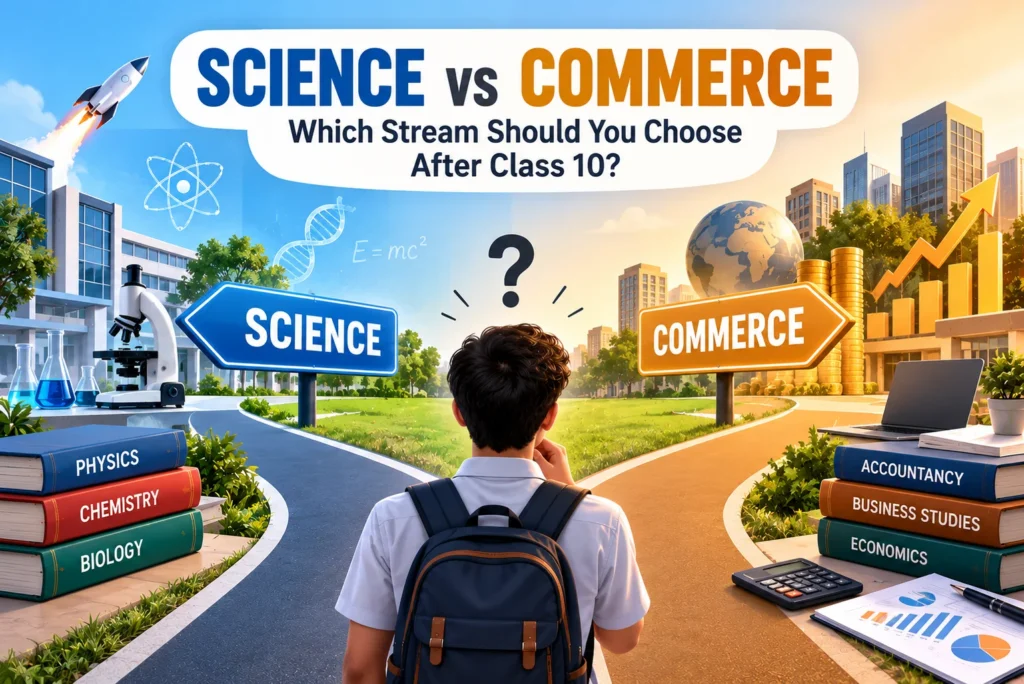
For many students who score well in Class 10, the real decision is not between three streams but between two: Science or Commerce. Both are popular, both lead to well paid and respected careers, and both involve numbers and analytical thinking. Yet they suit different kinds of students and lead to quite different paths. Comparing science vs commerce carefully, on subjects, skills, entrance exams, degrees and careers, helps you choose the stream you will enjoy and succeed in, rather than the one your friends or relatives expect.
This guide by vidyanirbhar is for Class 10 students and parents weighing these two streams. We compare what you will study, the skills each stream demands, the exams and degrees each opens, career paths, flexibility to switch later, and the questions that help you decide. We use the Institute of Chartered Accountants of India (ICAI) as a real example, because its rules show how a commerce linked professional career can be open to students from either stream.
What You Study in Each Stream
| Aspect | Science | Commerce |
|---|---|---|
| Core subjects | Physics, Chemistry, and Mathematics or Biology (or both) | Accountancy, Business Studies, Economics |
| Mathematics | Core for PCM students; optional or absent for PCB students | Optional at many schools; Applied Mathematics offered by some boards |
| Common electives | Computer Science, Informatics Practices, Biotechnology, Physical Education | Informatics Practices, Entrepreneurship, Legal Studies, Physical Education |
| Practical work | Regular laboratory practicals | Projects, case studies and practical accounting work |
| Nature of study | Conceptual, numerical and experimental | Numerical, analytical and business oriented |
Skills Each Stream Demands
Science rewards strong conceptual understanding, comfort with abstract problem solving, mathematical ability (for PCM), memory and application (for Biology) and patience with lengthy derivations and experiments. Students who enjoy asking why and how things work often thrive.
Commerce rewards accuracy with numbers, logical thinking about money and business, clear presentation of accounts and the ability to understand economic and business concepts. Students who enjoy practical, real world problems related to trade, finance and markets often thrive.
Both streams involve numbers, but the type of numerical work differs. Science mathematics is more abstract and theoretical, while commerce work such as accountancy is more structured and procedural.
Entrance Exams and Degrees After Class 12
| Path | Science | Commerce |
|---|---|---|
| Engineering and technology | JEE Main, JEE Advanced, state CETs for BTech | Generally not eligible without Physics and Mathematics |
| Medicine and health | NEET UG for MBBS, BDS, AYUSH; other routes for nursing and allied health | Not eligible |
| Commerce and business degrees | Eligible for BCom and BBA at many universities | BCom, BBA, BMS, economics |
| Professional accounting routes | Eligible for CA, CS and CMA routes | Natural fit for CA, CS and CMA routes |
| Computer applications | BCA, BSc Computer Science | BCA at many universities, sometimes with Mathematics required |
| Law, design, management | Eligible | Eligible |
A key point stands out: Science students can usually move into commerce degrees later, but Commerce students generally cannot move into engineering or medicine. This one way flexibility is why Science is often recommended to undecided students, though it only helps if the student can manage and enjoy the Science stream.
Real Example: ICAI and the Chartered Accountancy Route
The Institute of Chartered Accountants of India is a statutory body established under the Chartered Accountants Act, 1949, and it regulates the chartered accountancy profession in India. Its course structure is a good illustration of how a commerce linked profession treats students from different streams.
In October 2020, ICAI announced that students could register provisionally for the CA Foundation course after passing Class 10, with the registration becoming regular after they pass Class 12. Students can then take the Foundation examination after their Class 12 board examinations, subject to ICAI’s current rules. The Foundation route is not restricted to Commerce students; students from Science and other streams who meet the Class 12 requirement can also follow it. Details of the current scheme, eligibility and examination dates are published on the ICAI website.
The lesson is that choosing Science does not close the door to chartered accountancy, and choosing Commerce gives a head start because subjects such as Accountancy and Economics overlap with the Foundation syllabus. Students interested in CA should weigh this overlap when choosing their stream.
Career Paths Compared
Science careers: engineering in many branches, medicine and dentistry, pharmacy, nursing, research, architecture, information technology, data science, biotechnology, environmental science and defence technical entries, along with any career open to graduates of all streams.
Commerce careers: chartered accountancy, company secretaryship, cost and management accountancy, banking, investment and financial services, auditing, taxation, business management, marketing, entrepreneurship, actuarial science and economics.
Both streams also lead to management, law, civil services and many corporate roles. A BCom is a common next step for Commerce students, while Science students who later prefer business can also join it at many universities.
Workload, Coaching and Stress
Science, especially for students preparing for JEE or NEET, often involves heavy coaching alongside school, which can be demanding. Commerce students preparing for professional exams such as CA Foundation also study beyond school, but the pattern is usually different. Think honestly about how much extra preparation you are willing and able to do, and how you handle long term pressure.
Science With Mathematics as a Flexible Option
Students who are strong in mathematics but unsure about engineering often ask whether PCM keeps options open. It does: PCM students can pursue engineering, BSc in physical sciences, BCA, economics, commerce degrees, law, management and design. The trade off is the workload of Physics and Chemistry. If you dislike those subjects, Commerce with Mathematics may be a better route to economics, finance and analytics.
What Class 11 Feels Like in Each Stream
A typical Science student in Class 11 spends a large part of each week on Physics numericals, Chemistry reactions and Mathematics problems or Biology diagrams, along with laboratory practicals. The jump in difficulty from Class 10 is noticeable, especially in Physics and Mathematics, and many students take time to adjust. Regular revision and practice are essential.
A typical Commerce student spends time preparing accounts, understanding business concepts through case studies, and learning economic theory. Accountancy requires steady practice to avoid errors, while Business Studies and Economics require clear understanding and good answer writing. The adjustment is often smoother, but students who take Mathematics in Commerce face a similar jump in difficulty as Science students.
Science With Biology vs Commerce
Students who do not enjoy Mathematics sometimes compare Science with Biology (PCB) and Commerce without Mathematics. PCB keeps medicine, dentistry, nursing, pharmacy, allied health and life sciences open, but it closes engineering and limits some data and economics related degrees. Commerce without Mathematics keeps business, accounting and many arts based courses open, but may limit economics and analytics degrees. If you are drawn to healthcare and living sciences, PCB fits. If you are drawn to business and finance, Commerce fits. In both cases, think carefully before dropping Mathematics entirely.
Questions to Ask Seniors and Teachers
- What surprised you most about Class 11 in this stream?
- How many hours a week do students usually study outside school?
- Which students struggle most in this stream, and why?
- Which subject combinations does our school offer, and how good are the teachers in each?
- What did students from our school do after Class 12 in each stream?
How to Decide Between Science and Commerce
- Do you enjoy Physics and Chemistry, or just tolerate them? Science requires two years of both.
- Are you strongly interested in engineering or medicine? If yes, Science is necessary.
- Do business, money and economics interest you? If yes, Commerce fits naturally.
- How strong is your mathematics? Strong mathematics helps in both streams; weak mathematics makes PCM difficult.
- What does your evidence say? Look at subject wise marks in Classes 9 and 10 and teacher feedback.
A Note on Salaries and Expectations
Families often compare streams by expected salaries. Earnings in any field depend on the specific degree, institution, skills, city and individual performance, and headline figures in advertisements rarely reflect typical outcomes. Engineers, doctors, chartered accountants and finance professionals can all build rewarding careers, but each path involves years of effort. Choose the stream whose daily work you can enjoy, and the long term rewards are more likely to follow.
Pros and Limitations
| Science | Commerce | |
|---|---|---|
| Pros | Wide range of degrees, access to engineering and medicine, flexibility to switch to commerce later | Direct link to business and finance careers, head start for CA and similar routes, practical and relevant subjects |
| Limitations | Heavy workload, intense competition for top entrance exams, stress for students who dislike the subjects | No access to engineering or medicine, some degrees require Mathematics, professional routes take years |
Common Mistakes Students Make
- Choosing Science only because it is seen as more prestigious
- Choosing Commerce to avoid hard work, without real interest in business
- Dropping Mathematics in Commerce without checking degree requirements
- Ignoring clear dislike of Physics or Chemistry
- Assuming Commerce guarantees a high salary
- Following friends instead of personal evidence
Conclusion
The science vs commerce choice depends on what you enjoy, where your strengths lie and which careers interest you. Science keeps engineering, medicine and research open and allows a later move to commerce, while Commerce gives a direct, practical route to business and finance careers. The ICAI example shows that some professional paths welcome students from both streams. Vidya Nirbhar prepares these guides so that students can choose their stream with confidence. You can look ahead at degrees and colleges for both streams on VidyaNirbhar before you decide.
Frequently asked questions
Which is better, Science or Commerce?
Neither is better for everyone. Science suits students who enjoy Physics, Chemistry and Mathematics or Biology and want engineering, medicine or research. Commerce suits students interested in business, finance and economics. Choose the one that matches your interests, strengths and career plans.
Can a Science student do CA?
Yes. The CA Foundation route is open to students who meet ICAI's Class 12 requirement, regardless of stream. Science students may need to learn accounting and business concepts from scratch, while Commerce students have a head start because of overlapping subjects. Check ICAI's current rules.
Can a Commerce student do engineering?
Generally no. Engineering degrees usually require Physics and Mathematics in Class 12, often with Chemistry. Commerce students interested in technology can consider BCA or other computing degrees at universities that accept them, sometimes with Mathematics required. Check each university's rules.
Is Mathematics compulsory in Commerce?
Not at every school, but it is strongly recommended. Many economics, finance and analytics degrees prefer or require Mathematics, and it helps in professional exams. Some boards offer Applied Mathematics as an alternative. Check the courses you may want after Class 12.
Which stream is easier, Science or Commerce?
Ease depends on the student. A student who enjoys Physics and Chemistry may find Science easier, while one who likes business and accounts may find Commerce easier. Choose based on interest and strengths rather than perceived difficulty or what friends say.
Can I switch from Science to Commerce after Class 12?
Yes. Science students can join BCom, BBA, economics and many other commerce related degrees at many universities. Check eligibility rules, as some universities may require certain subjects or marks. Switching from Commerce to Science based degrees is much harder, often impossible.