
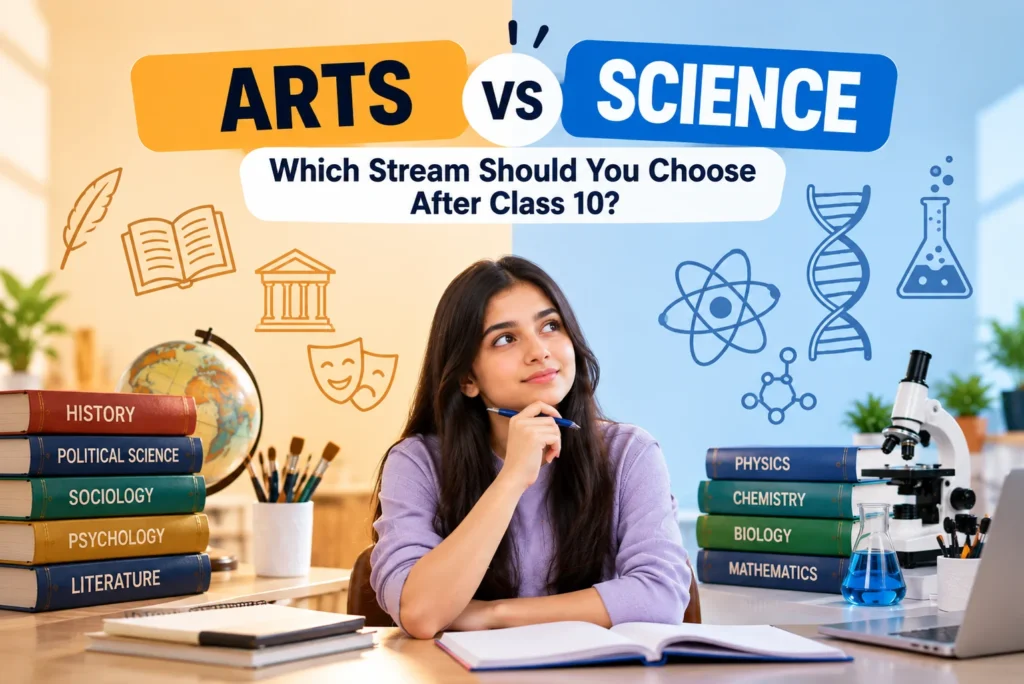
Arts and Science are often presented as opposites. Science is linked with laboratories, formulas and competitive exams, while Arts is linked with books, essays and debates. Many families still treat Science as the default for good students and Arts as a fallback. That view is outdated. Both streams lead to respected careers, both demand serious effort, and both reward curiosity. Comparing arts vs science honestly, on subjects, skills, careers and personal fit, helps you choose the stream where you will learn the most and enjoy the journey.
This guide by vidya nirbhar is for Class 10 students and their parents. We compare what each stream involves, the skills it develops, the degrees and careers it leads to, the question of switching later, and how to decide. We use Gujarat Arts and Science College in Ahmedabad, one of the oldest colleges in Gujarat, as a real example of an institution where arts and science departments have grown side by side for generations.
What Each Stream Involves
Science
Science covers Physics, Chemistry and either Mathematics, Biology or both, along with English and an elective. The focus is on understanding natural laws, solving numerical problems and carrying out experiments. The stream leads to engineering, medicine, pure and applied sciences and technology.
Arts or Humanities
Arts covers subjects such as History, Political Science, Geography, Economics, Sociology, Psychology, Philosophy, languages and Fine Arts. Students usually choose four or five subjects based on interest and availability. The focus is on understanding people, societies, cultures, institutions and ideas, through reading, analysis and writing.
Arts vs Science: Side by Side
| Factor | Arts or Humanities | Science |
|---|---|---|
| Core focus | Society, culture, behaviour, politics and ideas | Natural world, mathematics and technology |
| Main skills | Reading, writing, argument, interpretation, research | Problem solving, quantitative reasoning, experimentation |
| Study style | Reading heavy, essay based answers, discussions | Practice heavy, numerical problems, laboratory work |
| Subject choice | Wide range of combinations | Fixed core with limited electives |
| Key exams after Class 12 | CUET UG, CLAT, design and media tests | JEE, NEET UG, CUET UG, state CETs |
| Coaching culture | Usually lighter | Often intense for JEE and NEET aspirants |
Skills Each Stream Develops
Science develops logical reasoning, comfort with quantitative data, precision, persistence with difficult problems and an experimental mindset. These skills are valuable in technical, medical and research careers, and increasingly in data driven roles across industries.
Arts develops critical thinking, clear communication, the ability to build and evaluate arguments, cultural and social awareness and research skills. These skills are valuable in law, public service, media, education, policy, management and any role that involves understanding people and communicating well.
Degrees and Careers
| Arts Leads To | Science Leads To |
|---|---|
| BA in many subjects, integrated law, journalism, social work, psychology, design, fine arts | BTech, MBBS, BDS, BPharm, BSc in many subjects, BCA, architecture, nursing |
| Careers in law, civil services, media, teaching, counselling, policy, research, development sector, content and communication | Careers in engineering, medicine, research, technology, healthcare, data science, environmental science |
Some careers, including management, civil services, law and design, are open to both streams. A BA is the most common degree for Arts students and is also open to Science students at many universities.
Real Example: Gujarat Arts and Science College, Ahmedabad
Gujarat Arts and Science College in Ahmedabad, historically known as Gujarat College, traces its history to 1860 and describes itself as one of the oldest institutions in Gujarat. It is a government college affiliated to Gujarat University and recognised by UGC under Sections 2(f) and 12B. According to the college, it runs undergraduate programmes through a number of arts departments and science departments on a city centre campus, along with a full time drama programme. Information is available on the college’s official website.
For students weighing Arts against Science, an institution like this is a useful reminder that both streams have long, respected traditions in Indian higher education. On the same campus, students study history, economics, languages and psychology alongside physics, chemistry, botany and mathematics. As a government college, it also shows that quality education in both streams can be available at relatively affordable fees, though students should check current fees and admission rules for the year.
You can view Gujarat Arts and Science College, Ellisbridge, Ahmedabad on VidyaNirbhar. The lesson is that Arts and Science are parallel paths of equal standing, and the right choice depends on the student.
Can You Switch Later?
Switching options are uneven. Science students can usually move to Arts based degrees such as a BA, law, journalism or design after Class 12. Arts students generally cannot move into engineering or medicine, because those require Physics, Chemistry and Mathematics or Biology in Class 12. Some science degrees, such as a BSc in certain subjects, also require science subjects in Class 12.
This one way flexibility is often used as an argument for choosing Science. It is a fair point, but only if the student can handle and enjoy the Science stream. A student who struggles and loses interest in Science may perform poorly, which can limit options more than choosing Arts would have.
Workload and Stress
Science, especially with coaching for JEE or NEET, can involve long hours and high pressure. Arts involves extensive reading and writing, and students who choose it for interest often find the workload engaging rather than stressful. Both can be demanding. The key is whether the work matches what you enjoy, because enjoyment makes hard work sustainable.
Arts and Science Combined: Interdisciplinary Options
Many modern fields combine both. Psychology draws on biology and social science. Economics uses mathematics and social theory. Geography spans physical and human geography. Environmental studies, data journalism, public health and cognitive science all blend arts and science thinking. Under NEP 2020, undergraduate programmes increasingly allow majors and minors across disciplines, so your Class 11 choice does not have to cut you off from the other side entirely.
What Class 11 Feels Like in Each Stream
In Science, the jump from Class 10 is often sharp. Physics introduces calculus based ideas, Chemistry adds organic reactions and physical chemistry calculations, and Mathematics moves into more abstract topics. Biology students handle a large volume of concepts and diagrams. Practicals are a regular part of the week, and many students add coaching classes for entrance exams.
In Arts, students meet subjects in far greater depth than in Class 10 Social Science. History becomes a study of sources and interpretations, Political Science looks at constitutions and theories, and Psychology introduces research methods. Reading, note making and answer writing take up much of the week, and good students learn to build arguments supported by evidence.
Planning for Class 12 and Beyond
Whichever stream you choose, plan ahead for the exams and degrees you may want. Science students aiming at engineering or medicine should understand JEE or NEET timelines early, while those interested in research can look at science programmes at central universities through CUET UG. Arts students interested in law should prepare for CLAT, and those aiming at central universities should choose CUET domain subjects that match their target courses. Keeping a simple plan from Class 11 reduces last minute stress.
Talking With Parents
If parents prefer Science and you prefer Arts, or the other way round, share evidence rather than emotions alone: your marks, your interests, careers that suit each stream and the degrees they lead to. A calm conversation, perhaps with a teacher or counsellor present, often helps families reach a decision everyone can support.
How to Decide Between Arts and Science
- Which subjects do you enjoy reading about in your free time? Science topics, or history, politics and society?
- Where are your consistent strengths? Mathematics and Science marks, or Social Science and languages?
- What kind of work energises you? Solving problems and experiments, or reading, writing and discussing?
- Are engineering or medicine serious goals? If yes, Science is necessary.
- Which careers excite you? Check whether they need Science or welcome Arts students.
Questions to Ask Your School
- Which Arts subjects and combinations are offered, and is Psychology or Economics available?
- Can Arts students take Mathematics or Applied Mathematics?
- What electives are available to Science students?
- How did students in each stream perform in recent board exams?
Busting Common Myths
- Myth: Arts is for weak students. Reality: many high scoring students choose Arts for law, civil services, psychology and research.
- Myth: Science guarantees a good career. Reality: outcomes depend on the degree, institution, skills and effort.
- Myth: Arts has no jobs. Reality: Arts graduates work in law, media, education, policy, public service, design and corporate roles.
- Myth: Science students cannot be creative. Reality: research, design and innovation all need creativity.
Common Mistakes Students Make
- Choosing Science only because of family or social expectations
- Avoiding Arts because of stereotypes
- Ignoring a clear dislike of Physics, Chemistry or Mathematics
- Not checking which Arts subject combinations the school offers
- Overlooking interdisciplinary fields that combine both streams
- Deciding without looking at subject wise marks and teacher feedback
Conclusion
The arts vs science decision should rest on your interests, strengths and the careers that excite you, not on stereotypes. Science keeps technical and medical paths open, while Arts builds powerful skills for law, public service, media, education and more. Gujarat Arts and Science College shows that both traditions have long stood side by side with equal standing. vidya nirbhar prepares these guides so that students choose streams with confidence and clarity. You can look ahead at degrees and colleges for both streams on VidyaNirbhar as you make your choice.
Frequently asked questions
Which is better, Arts or Science?
Neither is better for everyone. Science suits students who enjoy mathematics, physics, chemistry or biology and want technical or medical careers. Arts suits students curious about people, society and ideas. Choose the stream that matches your interests, strengths and the careers you are considering.
Can Science students switch to Arts after Class 12?
Yes. Science students can usually join BA programmes, law, journalism, design and other arts based courses after Class 12, subject to each university's eligibility rules. The reverse is harder, because engineering and medicine require science subjects in Class 12, usually with set marks.
Is Arts a good stream for high scoring students?
Yes. Many high scoring students choose Arts out of genuine interest and go on to law schools, central universities, civil services and research. Strong analytical and communication skills built in Arts are valued in many careers, including management and public policy.
What are the best careers after Arts?
Popular careers include law, civil services, journalism and media, psychology and counselling, teaching, social work, design, public policy, international relations and research. Many corporate roles in human resources, communication and management also welcome Arts graduates with relevant skills and experience.
Is Science harder than Arts?
Difficulty depends on the student. Science involves heavy numerical and conceptual work, while Arts involves extensive reading and writing. A student who enjoys a stream usually finds it more manageable. Choose based on interest and strengths rather than perceived difficulty.