
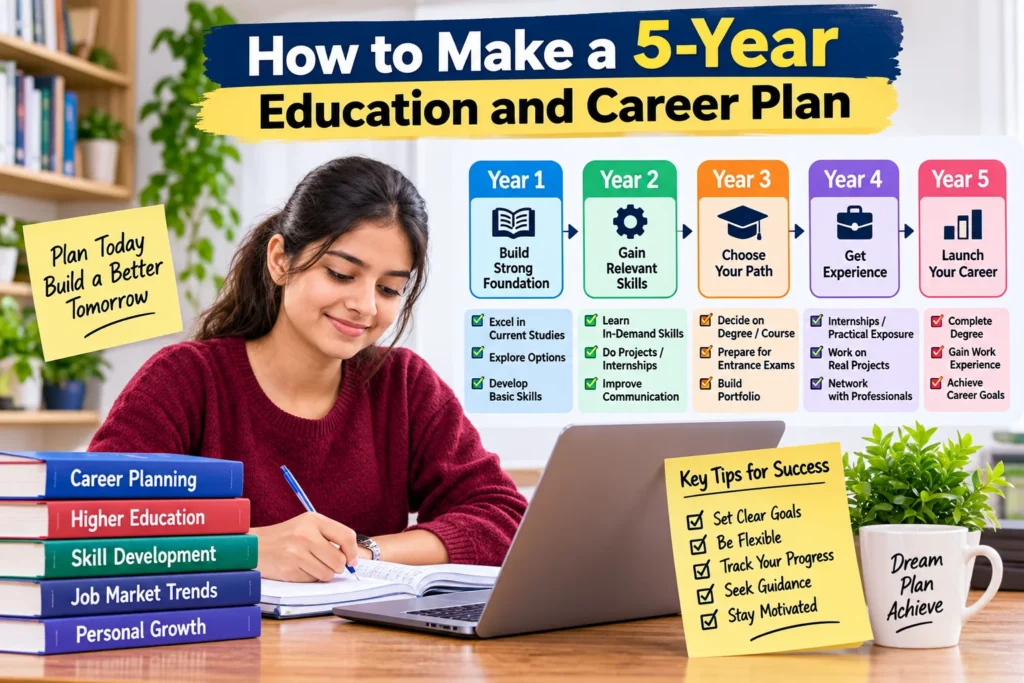
Five years can feel like a long time when you are 16 or 17, but in education it passes quickly. The years from Class 11 to the end of an undergraduate degree, or from graduation to your first promotion, shape where you will be at 25 or 30. A clear education and career plan does not lock you into one path. It gives you direction, helps you use each year well and makes it easier to adjust when circumstances change. Students who plan ahead tend to choose subjects, entrance exams and internships more deliberately, and waste less time and money on detours.
This guide by vidyanirbhar is for students in Classes 10 to 12, undergraduates and recent graduates, and for parents who want to support long term thinking. We explain how to set a five year goal, break it into yearly milestones, plan for exams, skills, finances and experience, build in backup routes and review the plan each year. We use the Academic Bank of Credits, a national initiative under the National Education Policy 2020, as a real example of how India’s higher education system now supports flexible, multi year planning.
Why a Five Year Horizon Works
A one year plan is too short to cover a degree, and a twenty year plan is too uncertain to be practical. Five years is long enough to include a full education stage, such as Class 11 to the second year of college, or a degree plus the first year of work, and short enough to plan realistically. It also matches common review points: board exams, entrance exams, graduation and first job.
Step 1: Define Where You Want to Be in Five Years
Start with a clear but flexible picture of your situation five years from now. Write it in a few sentences. For example: “In five years, I want to have completed a degree in economics, gained internship experience in a research or policy organisation, and be working as an analyst or studying for a master’s degree.” Your goal should describe:
- The education you want to have completed
- The skills and experience you want to have built
- The kind of role or next step you want to be ready for
- Any personal factors, such as location or financial independence
If you are unsure of the exact career, define the goal at the level of a field or career family rather than a single job title.
Step 2: Work Backwards to Yearly Milestones
Once you know where you want to be, ask what needs to happen each year to get there. Here is a sample plan for a student currently in Class 11 who is aiming for a career in finance:
| Year | Education Milestone | Skills and Experience | Key Decisions |
|---|---|---|---|
| Year 1 (Class 11) | Build strong foundations in Mathematics, Accountancy and Economics | Join a commerce or finance club, read business news | Shortlist degrees and entrance tests |
| Year 2 (Class 12) | Score well in board exams, appear for CUET UG or other tests | Short online course in spreadsheets | Choose university and programme |
| Year 3 (UG Year 1) | Complete first year with good grades | Join student societies, start learning data tools | Decide on electives or minor |
| Year 4 (UG Year 2) | Maintain grades, choose specialisation | First internship in a finance role | Decide on professional qualification or postgraduate route |
| Year 5 (UG Year 3) | Complete degree or continue into a fourth honours year | Second internship, build a portfolio of projects | Apply for jobs or postgraduate programmes |
Your table will look different, but the structure is the same: each year has an education target, a skills and experience target and one or two big decisions.
Step 3: Plan Entrance Exams and Application Deadlines
Many milestones depend on entrance exams and applications. List the exams relevant to your goal, such as CUET UG, JEE Main, NEET UG, CLAT, NCHM JEE or CAT, along with their usual application windows and exam months. Dates change every year, so check official websites each academic year and add reminders to your calendar. Planning exam preparation a year ahead reduces last minute pressure and allows you to balance coaching, school and rest.
Step 4: Plan Your Skills Beyond the Syllabus
Degrees provide knowledge, but employers and admission panels also look for practical skills. For each year, choose one or two skills to build. Examples include:
- Spreadsheets and data analysis
- Writing and presentation
- A programming language
- A second language
- Design or digital media tools
- Leadership through clubs, events or volunteering
Free and low cost online courses, including those on SWAYAM, make it possible to build these skills alongside your main studies.
Step 5: Plan Your Finances
Education costs vary widely. Estimate fees, hostel or rent, books, coaching and travel for each year in rupees. Then list possible sources of support: family savings, government and institutional scholarships, education loans and part time work. Applying for scholarships early, often through the National Scholarship Portal or state portals, can make a significant difference. A clear financial picture helps you choose institutions and routes that are sustainable for your family.
Real Example: The Academic Bank of Credits
The Academic Bank of Credits is a national digital platform launched in July 2021 under the National Education Policy 2020, with regulations issued by the University Grants Commission. It stores the academic credits that students earn from registered higher education institutions in a digital account linked to the student’s ID. These credits can be accumulated and, subject to institutional rules, transferred or used towards a qualification. Details of registration, participating institutions and current rules are published on the Academic Bank of Credits website.
For a five year plan, this matters because it supports the multiple entry and exit structure of the UGC Curriculum and Credit Framework. Under that framework, a student can earn a certificate after the first year, a diploma after the second, a degree after the third and an honours or honours with research degree after the fourth, with credits recorded along the way. A student who must pause studies for financial or family reasons can, in principle, return later and build on credits already earned. This makes long term plans more resilient. Each university applies these rules in its own way, so check the specifics before relying on them.
Step 6: Build Backup Routes Into the Plan
Good plans include alternatives. For each major decision, write down a backup. If you do not clear a particular entrance exam, which other programme will you choose? If your first choice university does not admit you, which colleges are on your list? If you change your mind about the field after two years, what postgraduate routes are open? A student aiming for management could plan for a regular degree followed by an MBA, with an integrated MBA as an alternative route straight after Class 12. Having backups ready reduces stress and prevents rushed decisions.
Step 7: Review and Adjust Every Year
A plan is a living document. Set a fixed time each year, such as after annual exams or at the start of a new academic year, to review it. Ask what went well, what did not, if your goal still feels right and what needs to change. It is normal for plans to shift as you learn more about yourself and the world. The purpose of planning is not to predict the future perfectly but to make each year count.
Plans for Different Starting Points
Starting After Class 10
Focus on stream choice, foundation building in Classes 11 and 12, entrance exams and the first years of a degree.
Starting After Class 12
Focus on choosing a degree, building skills and internships during college, and preparing for either a job or postgraduate study by the end of year five.
Starting After Graduation
Focus on your first job or postgraduate study, such as an MSc or MBA, professional qualifications, and building experience towards a mid level role by year five.
Simple Tools to Keep the Plan on Track
A plan only helps if you look at it regularly. Keep a one page summary of your five year goal and yearly milestones where you will see it, such as the first page of a notebook or a pinned note on your phone. Break the current year’s milestones into monthly tasks, for example finishing a chapter set, submitting a scholarship form or completing a short course. Use a calendar with reminders for exam registrations, application deadlines and scholarship windows. A simple spreadsheet can track your marks, skills learned, certificates earned and internships completed. Once every three months, spend half an hour checking progress against the plan and noting what needs attention. These small habits keep the plan practical rather than a document written once and forgotten.
Involving Your Family
Share your plan with your parents or guardians. They can help with finances, practical arrangements and perspective. Discuss your goal, milestones and backups openly, and listen to their concerns. A plan that your family understands and supports is much easier to follow.
Common Mistakes Students Make
- Setting a goal that is too vague or too rigid
- Focusing only on exams and ignoring skills and experience
- Not planning finances or scholarship applications early
- Having no backup for entrance exam or admission results
- Writing a plan once and never reviewing it
- Copying a friend’s plan without considering personal strengths
Conclusion
A clear education and career plan turns five uncertain years into a series of manageable steps. Define your goal, set yearly milestones, plan exams, skills and finances, build backups and review the plan every year. The Academic Bank of Credits shows how India’s higher education system now supports flexible, credit based progress that makes long term plans more resilient. Vidyanirbhar prepares these guides so that students can plan their education with purpose and confidence. You can compare courses and universities that fit each stage of your plan on VidyaNirbhar.
Frequently asked questions
How do I make a 5-year education and career plan?
Define where you want to be in five years, then work backwards to yearly milestones for education, skills and experience. Add entrance exam timelines, a financial plan and backup routes for each major decision, and review the plan every year to adjust it as needed.
What should a career plan include?
A career plan should include a clear goal, yearly education milestones, skills to build, experiences such as internships, entrance exams and deadlines, a budget with funding sources, backup options and a regular review date. Keeping it in one document makes it easier to follow.
Is it too early to plan my career in Class 10 or 11?
No. Planning in Class 10 or 11 helps you choose the right stream, subjects and entrance exams. Your plan can be flexible and focused on a field rather than a single job. Early planning simply gives you more time and fewer rushed decisions.
What is the Academic Bank of Credits?
The Academic Bank of Credits is a national digital platform launched in 2021 under NEP 2020. It stores credits earned from registered institutions and supports multiple entry and exit in higher education. Students can accumulate credits and, subject to institutional rules, use them towards qualifications.
What if my plan does not work out?
Plans often change, and that is normal. Use your backup routes, review what happened and adjust your goal or milestones. Skills and experience you have built remain valuable. A plan is a guide for making good decisions, not a promise that everything will go exactly as written.