
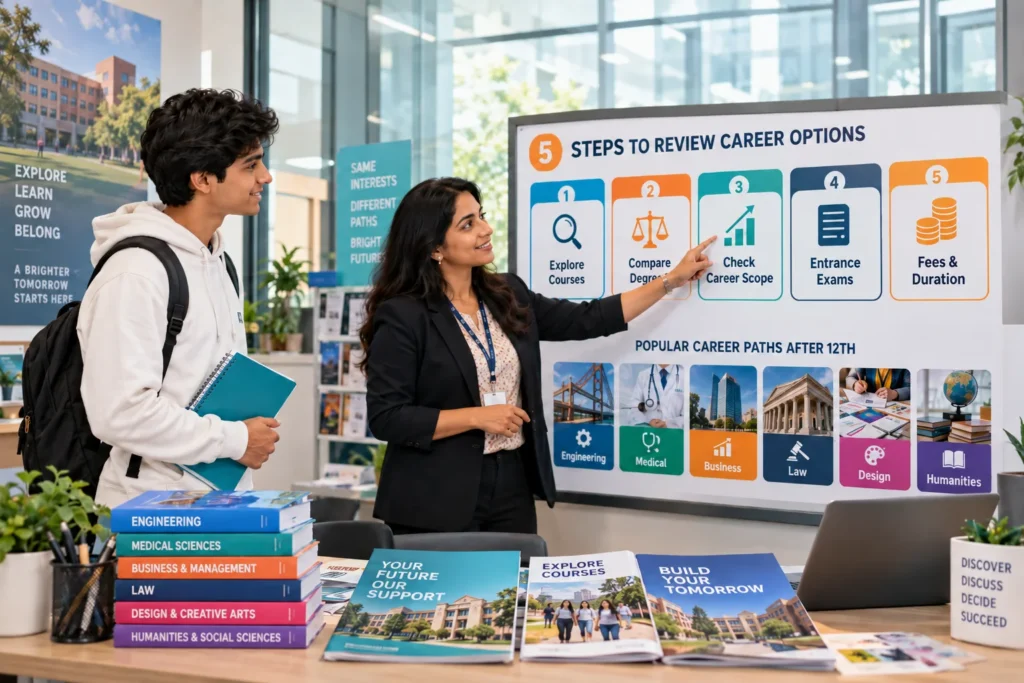
Most students choose a degree first and think about careers later. A smarter approach is to look at career options after 12th before you commit to a degree, so that the degree becomes a step towards something you actually want. India now offers a far wider range of paths than the familiar trio of engineering, medicine and commerce. There are integrated five year programmes, design and hospitality degrees, law after Class 12, research focused science programmes, management degrees straight after school and many skill based routes. Reviewing these options carefully helps you avoid narrow choices made under pressure.
This guide by vidyanirbhar is for Class 11 and Class 12 students and their parents. We explain how to build a wide list of career options, how to group them, how to check which degrees lead to each, how to compare integrated programmes with standard degrees, and how to narrow your list sensibly. We use the Integrated Programme in Management at IIM Indore as a real example of a newer type of programme that combines undergraduate and postgraduate study straight after Class 12.
Why Review Careers Before Choosing a Degree
A degree takes three to five years and a significant investment. If you choose it without knowing where it leads, you may find later that your preferred career needed a different degree, an entrance test you did not take or subjects you dropped. Looking at careers first lets you work backwards to the right degree, and also helps you notice options you may never have considered.
Step 1: Build a Wide List of Career Options
Start broad. Write down every career that interests you even slightly. Use these sources to widen the list:
- Career information on government portals such as the National Career Service portal.
- University prospectuses, which show the full range of degrees on offer.
- Entrance exam bulletins such as CUET UG, JEE, NEET UG, CLAT and design tests, which list participating programmes.
- Conversations with relatives, teachers, seniors and professionals in different fields.
- News and features about new and growing sectors.
At this stage, do not reject options too quickly. Aim for fifteen to twenty ideas, including at least a few you know little about.
Step 2: Group Options Into Career Families
| Career Family | Examples | Common Entry After Class 12 |
|---|---|---|
| Engineering and technology | Software, electronics, civil, mechanical, data science | BTech, BE, BSc, BCA |
| Health and medicine | Doctor, dentist, nurse, pharmacist, physiotherapist | MBBS, BDS, BSc Nursing, BPharm, allied health |
| Pure science and research | Physicist, biologist, chemist, mathematician | BSc, integrated BS MS |
| Business and management | Manager, consultant, entrepreneur, marketer | BBA, BMS, BCom, integrated management programmes |
| Finance and accounting | Chartered accountant, banker, analyst, actuary | BCom, economics, professional routes |
| Law and public service | Lawyer, judge, civil servant, policy analyst | Integrated BA LLB or BBA LLB, any degree for civil services |
| Design and creative | Fashion, product, communication and interior designers | BDes, BFA, architecture |
| Media and communication | Journalist, content creator, public relations professional | BA in journalism and mass communication |
| Hospitality and tourism | Hotel manager, chef, travel professional | Hospitality and hotel administration degrees |
| Education and social sector | Teacher, counsellor, social worker | BA, BSc, then BEd or MSW; integrated teacher education |
Step 3: Check the Degree Route for Each Option
For every career on your list, note the degree, entrance exam, Class 12 subject requirements and any further qualifications needed. You will quickly see that some careers have fixed routes, such as medicine or law, while others are open to graduates of many disciplines, such as management, media or civil services. This step often removes options that need subjects you do not have, and highlights options that fit your current stream well.
Integrated Programmes vs Standard Degrees
India now has several integrated programmes that combine undergraduate and postgraduate study, admitting students directly after Class 12. Examples include integrated management programmes, five year law programmes, integrated BS MS science programmes and integrated teacher education programmes.
| Factor | Integrated Programme | Standard Degree Then Postgraduate |
|---|---|---|
| Commitment | Early commitment to a field for five years | Decide on postgraduate study after three or four years |
| Entrance | One competitive entrance after Class 12 | Separate entrance tests at each stage |
| Flexibility | Lower; exit options vary | Higher; can change field after graduation |
| Time | Often saves a year compared to separate degrees | May take longer overall |
Real Example: The Integrated Programme in Management at IIM Indore
The Indian Institute of Management Indore, established in 1996, launched its five year Integrated Programme in Management (IPM) in 2011. It was the first undergraduate programme offered by an IIM. The programme combines a BA in foundations of management studies with an MBA, and admission is through the IPM Admission Test (IPMAT) followed by a personal interview. Details of eligibility, the test and fees for each year are published on the IIM Indore website.
The IPM shows how career options after 12th have widened. A student interested in management no longer has to complete a separate bachelor’s degree, work and then compete for an MBA; they can enter a management pathway directly after school. At the same time, it requires an early commitment to management as a field. Students considering such programmes should compare them with a BBA followed by an MBA later, weighing flexibility, cost and fit.
Step 4: Narrow Your List
Once you have routes for each option, narrow your list to three to five careers using these filters:
- Interest: which options still excite you after research?
- Fit: which match your skills and working style?
- Eligibility: which degrees can you realistically enter with your subjects and expected marks?
- Cost and time: which routes fit your family’s budget and timeline?
- Opportunities: which careers have openings where you want to live and work?
Step 5: Test Before You Commit
For your final shortlist, test each option. Take a short online course, attend a workshop or open day, read about a typical day in the job and talk to people working in the field. If possible, do a short internship or job shadowing. These experiences often confirm one option strongly or reveal that another suits you better.
An Illustrative Shortlisting Exercise
Imagine a Science student with Mathematics who begins with a list of eighteen careers, from software engineering and architecture to journalism and hotel management. After checking routes, the student removes medicine (no Biology) and keeps engineering, data science, architecture, actuarial science and management. After talking to professionals and attending two workshops, the shortlist becomes data science, actuarial science and management. The student then plans to apply for a BSc in statistics or data science, register for relevant entrance tests and keep an integrated management programme as a parallel option. This illustration shows how a broad list, honest research and testing lead to a focused, realistic plan.
A Simple Timeline for Classes 11 and 12
| When | Action |
|---|---|
| Class 11, first half | Build a wide list of careers and group them into families |
| Class 11, second half | Check degree routes, entrance exams and subject requirements; attend workshops |
| Class 12, first half | Narrow to three to five careers; talk to professionals; note exam registration dates |
| Class 12, second half | Register and prepare for entrance tests; finalise first choice and backup degrees |
Starting in Class 11 gives you time to test options without the pressure of board exams and entrance tests in Class 12.
Lesser Known Career Paths Worth Considering
- Hospitality and hotel administration: through national hotel management programmes.
- Design: fashion, product, communication and user experience design.
- Actuarial science and statistics: for students strong in mathematics.
- Agriculture, food technology and environmental science: growing fields with public and private roles.
- Aviation and logistics: including technical and management roles.
- Psychology and counselling: with further study and registration as required.
- Research in basic sciences: through integrated BS MS programmes.
Costs and Scholarships Across Career Paths
Different career paths carry very different costs. Integrated programmes at national institutes, private professional colleges and design schools can be expensive, while degrees at government and aided colleges are usually much cheaper. When reviewing options, note the total cost of each route, including hostel and living expenses, and check scholarships, fee waivers and education loan schemes early. Cost should not be the only factor, but a clear picture prevents painful surprises after admission.
Involving Your Family
Share your wide list and your research with your parents. They may know people in fields you are considering, and they can help you think about cost, location and stability. Explaining your reasons for shortlisting certain careers, with evidence from your research and experiences, helps families trust and support your choice.
Common Mistakes Students Make
- Choosing a degree first and thinking about careers only later
- Considering only the most familiar careers
- Rejecting options before checking routes and requirements
- Choosing integrated programmes without being sure about the field
- Missing entrance exam registration dates
- Not testing career options through real experience
Frequently asked questions
What are the main career options after 12th?
Options include engineering and technology, medicine and health, pure science and research, business and management, finance and accounting, law, design, media, hospitality, education and the social sector, along with civil services after graduation. Many of these are open to students from more than one stream.
Should I choose a career or a degree first?
It usually helps to look at careers first and then choose the degree that leads to them. This way, you can check subject requirements, entrance exams and further qualifications in advance, and avoid a degree that does not lead where you want to go.
Are integrated programmes better than standard degrees?
Integrated programmes can save time and offer a structured path, but they require early commitment to one field. Standard degrees followed by postgraduate study offer more flexibility to change direction. Choose based on how sure you are about the field and your preferred pace.
What is the IPM at IIM Indore?
The Integrated Programme in Management is a five year programme launched by IIM Indore in 2011, combining a BA in foundations of management studies with an MBA. Admission is through IPMAT and an interview. Check the institute's website for current eligibility and dates.
How do I narrow down career options after 12th?
Filter your list by interest, fit with your skills, eligibility for the required degrees, cost and time, and opportunities in your preferred locations. Then test your final shortlist through short courses, workshops, internships and conversations with professionals before deciding on a degree.