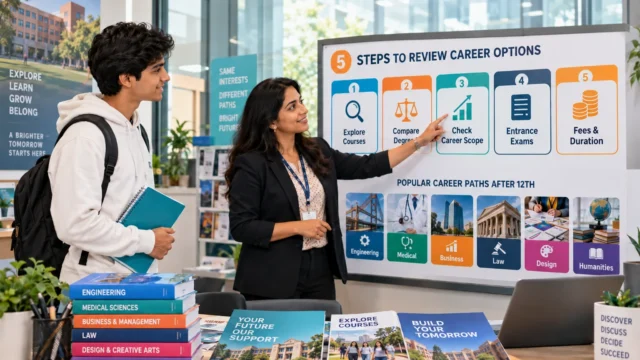

Not every student knows at 17 exactly what they want to do for the rest of their working life, and that is perfectly normal. Interests change, industries shift and new roles appear that did not exist a decade earlier. For students who are still deciding, choosing a degree with multiple career options is a sensible strategy. Such a degree builds skills that employers in many sectors value, keeps postgraduate routes open and allows you to specialise later, once you know more about yourself and the job market.
This guide by vidyanirbhar is for Class 11 and 12 students, their parents and anyone reconsidering their undergraduate plans. We explain what makes a degree flexible, which degrees tend to open the most doors, how to judge flexibility at the level of a specific institution, and how to add skills during college so that your options stay wide. We use Jadavpur University in Kolkata as a real example of a public university whose structure lets students build broad foundations across engineering, sciences and humanities.
What Makes a Degree Flexible?
A degree gives you multiple career options when it builds skills that transfer across sectors and does not tie you to a single licensed profession. Five features usually signal flexibility:
| Feature | Why It Matters |
|---|---|
| Transferable core skills | Writing, quantitative reasoning, analysis and problem solving are useful in almost every field |
| Wide postgraduate eligibility | Graduates can apply for an MBA, law, journalism, public policy or a master’s degree in related subjects |
| Eligibility for competitive exams | Any graduate can usually attempt civil services, banking and many government recruitment exams |
| Choice of electives and minors | Students can combine subjects and build a second strength |
| Strong employer recognition | Recruiters from many industries hire graduates of that discipline |
Professional degrees such as MBBS or a five year integrated law degree are excellent when you are sure of the career, but they are narrower by design. Flexible degrees trade some early specialisation for wider choice later.
Degrees That Usually Offer the Widest Options
BA in Economics or Social Sciences
Economics combines quantitative and analytical skills with an understanding of policy and markets. Graduates move into banking, consulting, research, data analysis, public policy, journalism and, after further study, management or law. A BA Economics with Mathematics or Statistics as a supporting subject is particularly versatile.
BSc in Mathematics, Statistics or Physics
Science degrees with a strong quantitative core open doors in data science, finance, research, teaching, software and actuarial work. They also keep the option of an MSc, MTech or MBA open.
BCom
A BCom builds knowledge of accounting, finance, taxation and business law. It supports careers in accounting, banking, auditing, financial analysis and business operations, and it pairs well with professional qualifications such as CA, CMA or CS.
BTech in Computer Science or Electronics
Engineering degrees in computing and electronics are technical but surprisingly flexible. Graduates work in software, hardware, product management, analytics and consulting, and many move into management after an MBA.
BBA and BMS
Management degrees give a broad view of business functions such as marketing, finance, operations and human resources. They suit students who want to keep several business careers open while gaining early exposure to how organisations work.
Real Example: Jadavpur University, Kolkata
Jadavpur University traces its roots to the National Council of Education, set up in 1906 during the Swadeshi movement to promote education under Indian control. It was established as a university on 24 December 1955 and is a state university of West Bengal. In the NIRF 2025 rankings it was placed 9th among universities, and it holds an A+ grade from NAAC. Official details of its faculties, programmes and admissions are available on the Jadavpur University website.
Jadavpur is a useful example because it brings engineering, science and arts faculties together on one campus. A student in an arts programme such as economics or comparative literature shares a campus culture with engineers and scientists, and engineering students study in a university that also has strong humanities departments. This breadth encourages students to build skills beyond their main subject, take part in societies and research projects across disciplines, and see a wider range of career paths through peers and alumni. Students considering it can also view the Jadavpur University profile on VidyaNirbhar.
The lesson is that flexibility depends not only on the degree name but also on the institution. A university that offers electives, interdisciplinary exposure and an active student community gives you more room to change direction than one with a narrow, fixed curriculum.
How to Judge Flexibility at a Specific College
Two colleges offering the same degree can differ greatly in how flexible the programme is. When shortlisting, check:
- Elective and minor options: Can you take courses outside your main subject, such as statistics, a language or computer applications?
- Four year options: Under the National Education Policy 2020 and the UGC Curriculum and Credit Framework, many universities now offer a four year honours or honours with research degree. This can help with postgraduate admissions and research careers.
- Multiple entry and exit: Some universities allow students to exit with a certificate after one year or a diploma after two, and return later. Check how your chosen university applies these rules.
- Internship and project requirements: Real work exposure helps you test careers during the degree.
- Placement and alumni spread: Look at the range of sectors where graduates work, not only the highest packages.
Combining a Flexible Degree With Targeted Skills
A flexible degree becomes more powerful when you add specific skills along the way. Consider these combinations:
| Degree | Added Skill | Careers It Can Support |
|---|---|---|
| BA Economics | Data analysis with spreadsheets and a programming language | Business analyst, research associate, policy analyst |
| BCom | Professional accounting qualification | Chartered accountant, auditor, financial controller |
| BSc Mathematics | Actuarial exams or data science certification | Actuary, data scientist, risk analyst |
| BA English | Digital content and marketing skills | Content strategist, copywriter, communications executive |
| BTech | Management or product courses | Product manager, technical consultant |
Online platforms such as SWAYAM offer courses from Indian institutions that can be taken alongside your degree. Short certificates, internships and projects all help you build a profile that fits more than one career.
An Illustrative Student Plan
Consider a Class 12 Science student with Mathematics who enjoys problem solving but is unsure whether to pursue technology, finance or research. Instead of forcing an early choice, the student enrols in a BSc in Statistics with Economics as a minor. In the first year, the student joins a finance club and takes a short programming course. In the second year, an internship at a market research firm shows that data work is enjoyable, while a finance project feels less engaging. By the third year, the student focuses on statistical computing, builds a small portfolio of analysis projects and prepares for either a master’s in data science or entry level analyst roles. This is an illustration, not a real case, but it shows how a flexible degree allows interests to settle before the student commits to one direction.
Keeping Postgraduate Doors Open
One of the biggest advantages of a flexible degree is the range of postgraduate options it supports. Most MBA programmes accept graduates from any discipline through entrance tests such as CAT. A three year LLB is open to graduates of any subject. Many master’s programmes in journalism, social work, development studies and public policy accept students from varied backgrounds. To keep these doors open, maintain good marks throughout your degree, since many postgraduate programmes and recruiters set minimum percentage requirements.
Balancing Flexibility With Direction
Flexibility is valuable, but too much indecision can leave you with a degree and no clear strengths. Use your first year to try different subjects and activities, your second year to narrow down two or three directions, and your final years to build depth in at least one. Employers and admission committees look for evidence that you have developed real skills, not only that you kept every option open.
When a Specialised Degree Is the Better Choice
If you are already certain about a regulated profession, such as medicine, architecture or pharmacy, a specialised degree is usually necessary because the profession requires it. Similarly, if you have a strong, tested interest in a specific field such as design, a focused degree may serve you better. The flexible approach suits students who are still deciding or who want careers where several degrees can lead to the same role.
Questions to Ask Before Finalising Your Choice
- Which careers can this degree lead to directly, and which after further study?
- Which postgraduate programmes and competitive exams will it make me eligible for?
- Does the college allow electives, minors or interdisciplinary courses?
- What do recent graduates of this programme actually do?
- Does the degree suit my strengths in mathematics, writing or science?
- Can I afford the fees in rupees, and what scholarships are available?
Common Mistakes Students Make
- Assuming any general degree is automatically flexible without checking the curriculum
- Dropping Mathematics in Class 12 and losing access to quantitative degrees
- Keeping options open for so long that no real skill is built
- Ignoring the role of electives, internships and projects in widening options
- Choosing a narrow professional degree without being sure of the profession
Conclusion
Choosing a degree with multiple career options gives you time to grow, test interests and specialise once you know more. Look for transferable skills, wide postgraduate eligibility, electives and strong employer recognition, and judge flexibility at the level of the specific institution. Jadavpur University shows how a campus that brings engineering, science and humanities together can widen a student’s outlook. Vidyanirbhar prepares these guides so that students who are still deciding can choose degrees that keep their future open. You can compare flexible degree programmes and universities across India on VidyaNirbhar.
Frequently asked questions
Which degree gives the most career options in India?
Degrees with strong transferable skills, such as BA Economics, BSc Mathematics or Statistics, BCom and BTech in computing, usually offer the widest options. Their value increases when you add electives, internships and targeted skills that match the careers you are considering.
Is a BA degree good for multiple career options?
Yes, a BA can support many careers, especially in economics, psychology, political science or English. Graduates move into civil services, media, research, policy, marketing and, after further study, law or management. Adding quantitative or digital skills widens options even further.
Can I change my career after choosing a general degree?
Yes. A general degree keeps many postgraduate routes open, including the MBA, three year LLB, journalism and social work. Competitive exams for government jobs are usually open to graduates of any discipline, so changing direction after a general degree is common and practical.
Should I choose a flexible degree or a specialised one?
Choose a flexible degree if you are still deciding or want careers that several degrees can lead to. Choose a specialised degree if you are certain about a regulated profession such as medicine or architecture, where a specific qualification is required by law.
How does the four year undergraduate degree help flexibility?
The four year honours option under NEP 2020 allows deeper study or research in the final year and can improve postgraduate prospects. Multiple entry and exit options also give students more control over their pace, though each university applies these rules differently.