
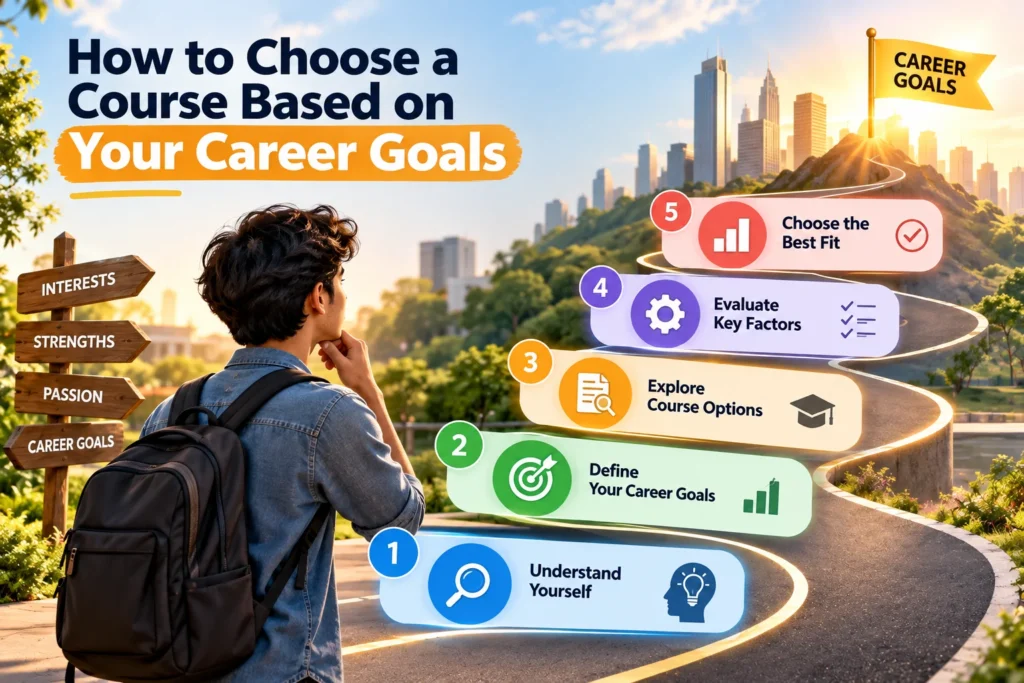
Some students know early what they want to become: a chartered accountant, a software engineer, a lawyer, a teacher, a civil servant or a designer. Others have a broad direction, such as working in business, healthcare or technology, without a specific job title in mind. In both cases, the smartest way to choose a course is to start from the career and work backwards. If you choose a course based on career goals, you can see which qualifications, entrance exams, skills and experiences you need, and avoid spending years on a degree that does not lead where you want to go.
This guide by vidya nirbhar is for Class 12 students, graduates and parents. We explain how to work backwards from a career goal, how to map careers to courses, how to check what employers and regulators require, how to plan for careers that need more than one qualification, and the mistakes to avoid. We use Nirma University in Ahmedabad as a real example of a university whose institutes are organised around professional career paths.
Step 1: Define Your Career Goal Clearly
A vague goal such as “a good job” makes course selection difficult. Try to describe your goal in specific terms:
- Field: technology, finance, law, healthcare, education, media, public service, research or design.
- Role: for example, data analyst, chartered accountant, corporate lawyer, school teacher or civil engineer.
- Work setting: government, private company, startup, non profit, own practice or academia.
- Timeline: how soon you want to start earning, and how many years of study you can manage.
If you are unsure, list two or three possible careers instead of one. You can then look for courses that keep more than one of them open.
Step 2: Work Backwards to the Required Qualifications
For each career on your list, find out what qualifications are required or preferred. Some careers have fixed, regulated routes. Others are open to graduates from many disciplines.
| Career | Typical Qualification Route | Regulated? |
|---|---|---|
| Doctor | MBBS through NEET UG, then internship and registration | Yes, by the National Medical Commission |
| Lawyer | Five year integrated LLB after Class 12, or three year LLB after graduation, then enrolment with a State Bar Council | Yes, by the Bar Council of India |
| Engineer | BTech or BE through JEE or state CETs | Technical institutions approved by AICTE |
| School teacher | Graduation plus BEd, or an integrated teacher education programme, and eligibility tests where required | Teacher education regulated by NCTE |
| Chartered accountant | Professional route through ICAI examinations, often alongside a BCom | Yes, by ICAI |
| Manager | Any degree, often followed by an MBA | MBA programmes approved by AICTE or offered by universities |
| Civil servant | Any bachelor’s degree from a recognised university, then UPSC or state public service exams | Recruitment rules by the commissions |
| Data analyst | Degrees in statistics, mathematics, computer science, economics or related fields, plus skills | Not regulated; skills based |
This exercise often shows that some careers allow many routes, while others have only one. For regulated careers, the course choice is largely fixed. For open careers, you can choose a course you enjoy and build the required skills alongside it.
Step 3: Research the Career Itself
Before committing to a long course, learn what the career involves day to day. Read job descriptions on reputable job portals and government portals. The National Career Service portal of the Ministry of Labour and Employment lists job roles and vacancies and offers career information that can help you understand typical requirements. Talk to people already working in the field and ask about their routine, challenges, entry routes and growth.
This research helps you check that the career matches your interests and working style, not just its reputation. It also helps you identify skills and experiences that matter alongside the degree.
Step 4: Map Courses to Your Career
Once you know the qualification route, list the courses that lead to it. For many careers, there are direct and indirect options:
- Direct: a course designed for the career, such as MBBS for doctors or integrated LLB for lawyers.
- Foundation plus professional: a degree followed by a professional or postgraduate qualification, such as a BCom followed by CA, or any degree followed by an MBA.
- Skills based: a degree in a related field plus certifications, projects and internships, common in technology, media and design.
Compare the routes on duration, cost, entrance requirements and flexibility. Direct routes are often faster to the profession, while foundation routes keep more options open if your goals change.
Real Example: Career Focused Institutes at Nirma University
Nirma University in Ahmedabad, Gujarat, is a private university established in 2003 and run under the Nirma Education and Research Foundation. Its academic structure is organised into institutes that map closely to professional careers, including an Institute of Technology offering engineering programmes, an Institute of Management, an Institute of Pharmacy, an Institute of Science and an Institute of Architecture and Planning, along with law programmes. The university has been accredited by NAAC with an A+ grade in its third cycle.
For a student working backwards from a career goal, this structure is helpful. A student aiming at engineering would look at the Institute of Technology’s BTech branches and admission through the relevant entrance route. A student aiming at pharmacy would look at the Institute of Pharmacy, which is also governed by Pharmacy Council of India norms. A student aiming at management could plan a degree followed by an MBA. Each programme has its own eligibility, admission process, fees and placement reports for the year, which students should check on the university’s official website.
You can view Nirma University on VidyaNirbhar. The broader lesson is that career goals often point to a specific type of institute or school, and checking the right unit within a university saves time.
Step 5: Check What Employers and Regulators Expect
For regulated careers, check the regulator’s rules on recognised institutions, minimum qualifications and registration. A law degree, for example, must come from a centre of legal education approved by the Bar Council of India for you to enrol as an advocate. An LLB from an unapproved centre can block your career.
For open careers, look at what employers ask for in job postings. Note the degrees, skills, tools, certifications and experience mentioned most often. This tells you what to build during your course, beyond the syllabus.
Two Worked Career Maps
Goal: become a chartered accountant. Work backwards: the route runs through ICAI’s examinations and practical training. Many students pair this with a BCom, because the subjects overlap and a degree adds a fallback qualification. The course choice after Class 12 is therefore a BCom at a college with a timetable that leaves room for professional exam preparation, plus registration with ICAI at the right stage. Check ICAI’s current scheme for the exact levels and eligibility.
Goal: become a data analyst. Work backwards: this is an unregulated, skills based career. Employers usually look for strong statistics, spreadsheet and programming skills, and the ability to explain findings. Suitable degrees include statistics, mathematics, economics, computer applications or computer science. The course choice is less fixed, so pick the one you enjoy most, then add projects, internships and certifications that show practical ability.
Building Skills Alongside Your Degree
For most careers, the degree is necessary but not enough. Use your college years to build a portfolio of skills and experiences that match your goal. This can include internships, part time work, research assistance, competitions, volunteering, online courses from recognised platforms and student clubs. Keep a record of each experience, what you did and what you learned. When you apply for jobs or further study, this record shows that you have prepared deliberately for your chosen career.
Planning for Careers That Need Several Steps
Many careers in India involve more than one stage. Becoming a chartered accountant involves several levels of ICAI exams and practical training. Becoming a professor typically involves a master’s degree, qualifying an eligibility test such as UGC NET or a PhD, and teaching experience. Civil services involve graduation and multiple stages of examinations.
For such careers, plan your course so it supports the later stages. Choose subjects that help with later exams, keep your marks strong where eligibility depends on them, and use your college years to build skills and experience step by step.
What If Your Career Goal Changes?
Career goals often change as students learn more about themselves and the world of work. This is normal. To protect yourself:
- Prefer courses that build transferable skills, such as analysis, writing, communication and digital skills.
- Use electives and minors, where NEP 2020 frameworks allow, to try related fields.
- Take internships in different settings to test your interests.
- Remember that postgraduate study and professional courses allow later changes of direction.
Common Mistakes Students Make
- Choosing a course first and thinking about careers only in the final year
- Assuming every course in a field leads to the same career
- Ignoring regulator approval for professional courses
- Choosing careers only for salary figures seen online
- Underestimating the number of steps some careers require
- Not building skills and experience alongside the degree
Conclusion
When you choose a course based on career goals, you start with the end in mind: define the career, work backwards to the qualifications, check regulator and employer requirements, and compare routes on duration, cost and flexibility. The Nirma University example shows how career goals can point to specific institutes within a university. vidya nirbhar prepares these guides to help students connect their studies to the futures they want. You can compare career focused courses and institutions on VidyaNirbhar as you plan your path.
Frequently asked questions
How do I choose a course based on my career goals?
Define your career goal clearly, then work backwards to the qualifications it needs. List direct and indirect course routes, check regulator and employer requirements, and compare routes on duration, cost and flexibility. Talk to people working in the field before finalising your choice.
What if I do not have a clear career goal yet?
List two or three careers that interest you and choose a course that keeps them open. Broad degrees with strong transferable skills, along with internships and electives, help you test options. Many students clarify their goals during college, and that is perfectly normal.
Do all careers require a specific degree?
No. Regulated careers such as medicine, law, pharmacy and teaching need specific qualifications from approved institutions. Many other careers, such as management, civil services, media and data analysis, accept graduates from various disciplines who have the right skills and qualifications.
Is it better to choose a direct professional course?
A direct course is often the fastest route to a regulated profession, but it is more specialised. A foundation degree followed by a professional or postgraduate qualification keeps more options open. Choose based on how certain you are about your career and your time and budget.
Where can I find reliable career information in India?
Use the National Career Service portal, regulator websites, official recruitment notices, university placement reports and conversations with professionals. Treat coaching advertisements and social media claims with caution, and verify salary or job figures with reliable sources before relying on them.