In many Indian universities, the degree you earn is formally awarded at a convocation, and the document you receive is often called a convocation certificate or convocation degree. It is the permanent proof that the university has conferred your degree, and it is required for government jobs, higher study abroad, professional registrations and many verification processes. Yet every year, thousands of graduates never apply, assuming the certificate will reach them on its own. Knowing how to apply for a convocation certificate, when to apply and which documents to keep ready saves you from rushed applications later in life.
This guide by vidyanirbhar is for final year students, recent graduates and alumni who have not yet collected their convocation certificate. We explain what the certificate is, how it differs from other documents, the usual application steps, documents, fees and timelines, options for graduates who cannot attend the ceremony, and what to do about errors or lost certificates. We use the University of Rajasthan as a real example of a large state university that awards degrees through convocation procedures.
What Is a Convocation Certificate?
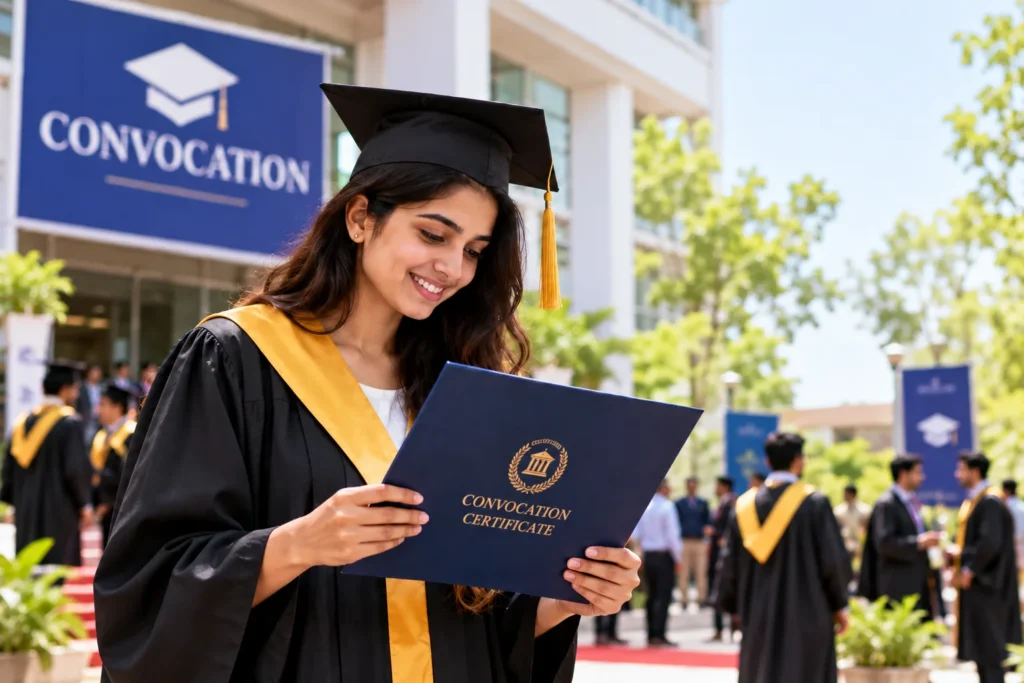
A convocation certificate is the formal degree certificate awarded by a university at, or in connection with, its convocation. Some universities call it the degree certificate, others the convocation degree, and some issue it at the ceremony while others post it afterwards. Whatever the name, it is the final, permanent document confirming your qualification.
| Document | Purpose | When Issued |
|---|---|---|
| Mark sheets | Record marks or grades for each semester or year | After each examination |
| Provisional certificate | Temporary proof of passing | Soon after final results, often on application |
| Convocation or degree certificate | Permanent award of the degree | At or after convocation, on application |
| Migration certificate | Permission to move to another university | On application |
Who Is Eligible to Apply?
Generally, students who have passed all examinations for their degree within the period covered by a convocation are eligible. Universities usually announce which batches and passing years a particular convocation covers. Students with pending papers, withheld results or unpaid dues may need to resolve these before applying. Graduates from earlier years who missed previous convocations can usually apply too, sometimes with a late fee.
Step 1: Watch for the Convocation Notice
Universities publish convocation notices on their official websites, often a few months before the ceremony. The notice usually includes:
- Batches and years of passing covered
- Application dates and last date with or without late fee
- Fees for in person and in absentia degrees
- Documents required
- Mode of application, online or through the college
- Ceremony date, venue and dress code, if attending
Ask your college office to inform you when the notice is released, and check the university website regularly after your final results.
Step 2: Gather Documents
- Final or consolidated mark sheet
- Provisional certificate, if already issued
- University enrolment or registration number and final exam roll number
- Identity proof, such as Aadhaar
- Recent passport size photograph
- Proof of name change, such as a gazette notification or marriage certificate, if applicable
Make sure your name and date of birth match across documents. Inconsistencies are one of the most common reasons for delayed or incorrect certificates.
Step 3: Fill the Application
Most universities now accept applications online. Typical steps are:
- Visit the university’s convocation or degree portal.
- Enter your enrolment number, roll number and year of passing.
- Verify the personal and academic details shown, or enter them if required.
- Choose to receive the degree in person or in absentia, and select postal delivery or collection if offered.
- Upload your photograph and documents.
- Pay the fee online.
- Submit and download the acknowledgement.
Where applications are offline, collect the form from your college or the university, attach documents and the fee receipt, and submit within the deadline, keeping an acknowledgement slip.
Real Example: University of Rajasthan
The University of Rajasthan was established in 1947 as the University of Rajputana and took its present name in 1956. Based in Jaipur, it is a state university with campus departments and a large number of affiliated colleges across its jurisdiction. Like many state universities, it confers degrees through convocation and publishes notices about degree applications, fees and distribution on its official website, covering students of both its departments and affiliated colleges. Graduates follow the procedure notified for their year of passing. Current notices and forms are available on the University of Rajasthan website.
The example shows how graduates of large affiliating universities need to watch for notices and apply actively. A graduate of an affiliated college in Jaipur, for instance, may find that degrees for several passing years are covered by a single convocation, with separate fees for attending or receiving the degree in absentia. Students can also view the University of Rajasthan profile on VidyaNirbhar.
In Person or In Absentia?
| Option | Advantages | Points to Note |
|---|---|---|
| In person | Receive the degree at the ceremony, share the occasion with family and classmates | Requires travel, registration and following dress codes and schedules |
| In absentia | Convenient for graduates working or studying elsewhere | Degree arrives by post or must be collected later; keep your address updated |
Both options give you the same degree. Choose based on your location, schedule and how much the ceremony means to you and your family.
Why the Convocation Certificate Matters
Mark sheets and provisional certificates serve many purposes, but the convocation certificate is the document that institutions treat as final. Government recruitment verification, foreign university admissions, credential evaluation for jobs abroad, professional council registrations and some promotions specifically ask for it. Postgraduate admissions in India, for example to an MBA or a master’s programme, may accept a provisional certificate at first but ask for the degree later. Having the certificate in hand before these moments saves time and avoids last minute requests to the university.
Preparing for the Ceremony
If you choose to attend convocation in person, read the ceremony instructions carefully. Universities usually issue a reporting time, seating arrangement, dress code and details of where to collect gowns or stoles. Carry your registration slip, identity proof and fee receipt. Medal winners and research scholars may receive their degrees on stage, while other graduates collect them at counters arranged by faculty or college. Check your certificate before leaving the venue and report any error at the help desk the same day, when correction is simplest.
Attestation and Apostille for Use Abroad
If you plan to study or work abroad, you may need your convocation certificate attested or apostilled. In India, this usually involves verification by the issuing university and the state education department, followed by attestation or apostille through the Ministry of External Affairs, often via authorised service centres. Requirements depend on the destination country. Start early, since the process can take several weeks, and never hand original documents to unofficial agents.
Fees and Timelines
Convocation fees vary by university and by option, and late fees often apply after the main deadline. Some universities charge more for in absentia degrees because of postage. Timelines also vary: some universities hold convocation every year, while others hold it less frequently, so degrees may take several months to over a year after results. If you need proof sooner, use a provisional certificate and check DigiLocker for a digital degree.
Checking Digital Copies
Many universities now upload degrees to the National Academic Depository, which graduates can access through DigiLocker. After convocation, sign in to DigiLocker, search for your university and fetch your degree using your roll number and year of passing. A digital copy is useful for quick sharing with employers and institutions, while the printed certificate remains important for formal verification. If your degree does not appear, ask the university’s examination section when your batch will be uploaded, giving your roll number and year.
Applying After Many Years
Graduates who passed years ago can usually still apply. Expect to provide old mark sheets, enrolment details and identity proof, and possibly pay a late fee. The university may take longer to verify old records. If the online portal does not cover your year, write to the degree or examination section with your details.
Lost, Damaged or Incorrect Certificates
- Lost or damaged: apply for a duplicate with an affidavit, a police or lost document report where required, copies of mark sheets and the duplicate fee.
- Incorrect details: apply for correction with proof such as your Class 10 certificate, and return the incorrect certificate if asked.
- Never received after posting: contact the university with your application number and postal tracking details, if any.
Never alter a certificate yourself. Altered documents can be rejected and may lead to legal action.
Common Mistakes Graduates Make
- Assuming the certificate will be sent automatically
- Missing the convocation application deadline
- Giving an outdated address for in absentia dispatch
- Ignoring name or date of birth mismatches
- Not keeping fee receipts and acknowledgements
- Waiting until a job or visa requires the degree
Conclusion
Knowing how to apply for a convocation certificate ensures you hold permanent proof of your degree when it matters. Watch for convocation notices, keep consistent documents ready, apply within the deadline, choose in person or in absentia, and follow up until the certificate reaches you. The University of Rajasthan shows how large affiliating universities confer degrees through convocation procedures that graduates must follow actively. Vidyanirbhar prepares these guides so that graduates can secure their documents without avoidable delays. You can find university profiles and contact details on VidyaNirbhar.
Frequently asked questions
How do I apply for a convocation certificate?
Watch for your university's convocation notice, gather mark sheets, enrolment details, identity proof and a photograph, and apply online or through your college within the deadline. Choose in person or in absentia, pay the fee and keep the acknowledgement until you receive the certificate.
Is a convocation certificate the same as a degree certificate?
In most universities, yes. The convocation certificate is the formal degree certificate conferred at or after convocation. Different universities use different names, but it is the permanent document confirming your qualification, unlike a provisional certificate, which is temporary and valid only until the degree is issued.
Can I get my convocation certificate without attending the ceremony?
Yes. Most universities offer an in absentia option, where you apply, pay the relevant fee and receive the certificate by post or collect it later. Keep your postal address and phone number updated so the certificate reaches you safely, and save the dispatch details.
How long does it take to get a convocation certificate?
It depends on the university's convocation schedule. Some issue degrees within a few months of results, while others take a year or more. Use a provisional certificate in the meantime, and check DigiLocker for a digital degree if your university uploads one.
What if I passed many years ago and never applied?
You can usually still apply. Contact the university's degree or examination section, provide old mark sheets, enrolment details and identity proof, and pay any late fee. Verification of older records may take longer, so apply well before you need the certificate.