
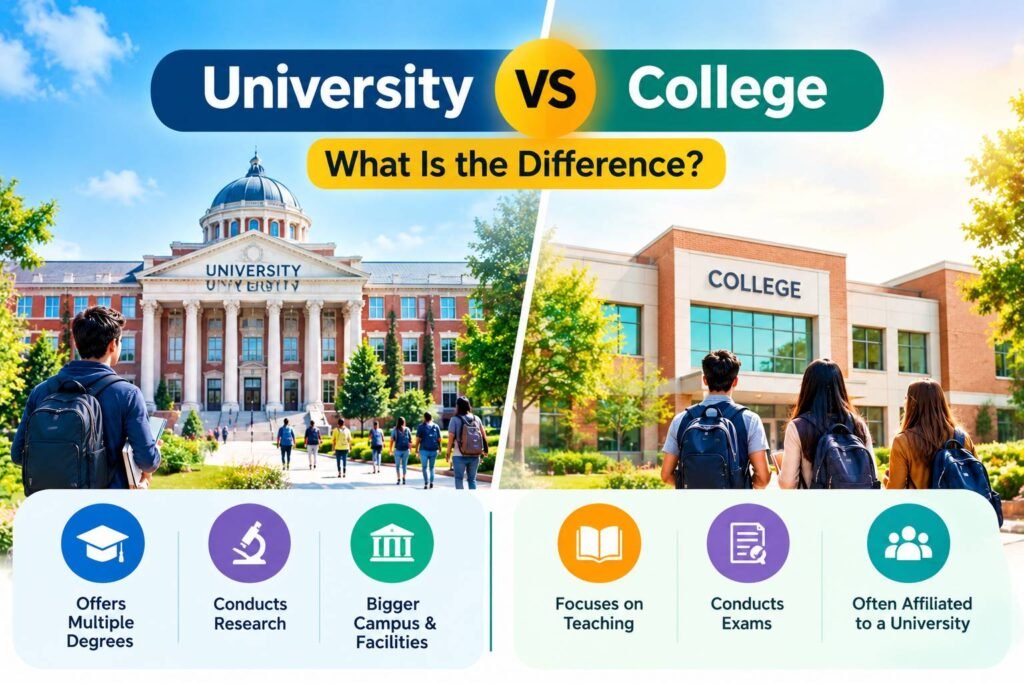
“Beta, which college did you get?” and “Which university are you in?” You must have heard both these questions after your 12th result. Most people in India use the words college and university as if they mean the same thing. But they are not the same, and knowing the difference can help you choose the right place for your higher studies.
In this guide, we will explain university vs college in very simple language. You will learn what each one means, the main differences between them, where your degree actually comes from, and which option may be better for you after 12th.
Quick Answer: University vs College
A university is a large higher education institution created by law that can award its own degrees. A college is usually a smaller institution that teaches students but cannot award degrees on its own; it is affiliated to a university, which conducts the final exams and gives the degree. In short, a college teaches you, but a university certifies you.
What Is a University?
A university is a higher education institution that is set up by a Central Act, a State Act, or is declared a “deemed to be university” by the Central Government on the advice of UGC. The most important thing about a university is that it has the legal power to award degrees in its own name.
As per Section 2(f) of the UGC Act, 1956, only institutions created or recognised under law can be called universities. That is why no institute can simply put the word “university” on its board.
A university usually does three main jobs:
- Teaches students in its own departments on the main campus.
- Conducts research and runs PhD programmes.
- Holds exams, declares results and awards degrees, including to students of its affiliated colleges.
As per the Press Information Bureau, India had 1,338 universities as of June 2025.
Examples: University of Delhi, University of Mumbai, Banaras Hindu University (BHU), Anna University, Osmania University.
What Is a College?
A college is an institution where students study for diploma, undergraduate and sometimes postgraduate courses. In India, most colleges do not have the power to award degrees on their own. They are affiliated to a university, which means they follow the university’s syllabus, their students write the university’s exams, and the final degree is issued by the university.
Colleges are much more in number than universities. According to the same PIB note, India had 52,081 colleges as of June 2025. So for most students, especially in smaller cities and towns, the college is the place where they actually attend classes.
Types of Colleges in India
- Government colleges: Run and funded by the state or central government. Fees are low.
- Government-aided colleges: Run by a private trust or society but get financial help from the government, for example many old colleges in Maharashtra, Kerala and West Bengal.
- Private (self-financed) colleges: Run by private trusts or societies without government funds. Fees are generally higher.
- Autonomous colleges: Still affiliated to a university, but allowed to make their own syllabus and conduct their own exams.
- Constituent colleges: Colleges that are a part of the university itself and are run directly by it.
- Professional colleges: Colleges for specific fields like engineering, medical, law, pharmacy, nursing or teacher training (BEd).
Examples: St. Stephen’s College (Delhi), Loyola College (Chennai), Fergusson College (Pune), Presidency College (Chennai), St. Xavier’s College (Mumbai).
University vs College: Comparison Table
Here is a side-by-side comparison so you can understand the difference in one look.
| Basis | University | College |
|---|---|---|
| Meaning | A large institution created by law with degree-giving power | An institution that teaches students and is usually linked to a university |
| Legal status | Set up by a Central or State Act, or declared deemed by the Centre | Registered by a trust, society or government; gets affiliation from a university |
| Power to award degrees | Yes | No (degree is issued by the affiliating university) |
| Exams | Conducts its own exams | Students write the university’s exams (autonomous colleges set their own papers) |
| Syllabus | Designs its own syllabus | Follows the university’s syllabus (except autonomous colleges) |
| Size | Big campus, many faculties and departments | Smaller campus, limited courses |
| Courses | UG, PG, MPhil (discontinued now), PhD, diplomas, certificates | Mostly UG and some PG courses |
| Research and PhD | Strong focus, runs PhD programmes | Limited; only some colleges are approved research centres |
| Regulated by | UGC and the relevant councils | Affiliating university, UGC and the relevant councils |
| Colleges under it | Can have hundreds of affiliated colleges | Cannot have other colleges under it |
| Head | Vice-Chancellor | Principal |
| Number in India | 1,338 (June 2025) | 52,081 (June 2025) |
| Examples | University of Delhi, University of Mumbai, BHU | Hindu College, Fergusson College, Loyola College |
Key Differences Between University and College Explained
The table gives you the summary. Now let us understand each difference in a little more detail.
1. Degree-Awarding Power
This is the biggest difference. A university can print and award a degree in its own name. A college cannot. Even if you study all three years at a college, your BA, BSc or BCom degree certificate will carry the name of the university the college is affiliated to.
2. Legal Status and Recognition
A university is created by an Act of Parliament or a State Legislature, or declared deemed by the Central Government. A college is started by the government, a trust or a society, and then it has to apply to a university for affiliation. The university checks the college’s building, faculty and facilities before giving affiliation.
3. Exams and Results
In a university, the exam department (headed by the Controller of Examinations) makes the question papers, holds exams and declares results. In an affiliated college, the college only conducts classes and internal assessments. The main semester or annual exams are held by the university.
4. Syllabus and Courses
Universities design the syllabus for every course they offer, and all affiliated colleges must follow it. A university also offers a much wider range of courses, from UG to PhD. A college usually offers a few popular courses like BA, BSc, BCom, BBA or BCA, and some PG courses.
5. Size and Infrastructure
Universities generally have larger campuses with many departments, big central libraries, research labs, hostels and sports complexes. Colleges are usually smaller. But smaller does not always mean worse. Many top colleges have excellent faculty and a very good academic environment.
6. Research Opportunities
Universities run PhD programmes and get research funding from bodies like UGC, DST and ICSSR. If you are interested in research or want to become a professor, a university department gives you more exposure. Some colleges are approved as research centres, but this is not common.
7. Administration
A university is led by a Vice-Chancellor, with a Registrar, Deans and Heads of Departments. A college is led by a Principal, with Heads of Departments and teaching staff under them.
Similar Terms That Confuse Students
While searching for admission, you will see many terms like affiliated, autonomous, constituent and deemed. Here is what each one means in simple words.
| Term | What it means | Can it award its own degree? | Example |
|---|---|---|---|
| Affiliated College | A college linked to a university; follows its syllabus and exams | No | Most colleges under state universities |
| Autonomous College | Affiliated college with freedom to set its own syllabus, exams and results | No, degree is still issued by the parent university | Loyola College, Chennai; St. Xavier’s College, Mumbai |
| Constituent College | A college that is part of the university and run or maintained by it | No, degree is issued by the university | Colleges of the University of Delhi |
| Deemed to Be University | An institution given university status by the Centre on UGC’s advice | Yes | BITS Pilani, Manipal Academy of Higher Education |
| Institute of National Importance (INI) | An institute created by a special Act of Parliament | Yes | IITs, NITs, AIIMS, IIMs |
Is IIT a College or a University?
An IIT is neither called a college nor a university. It is an Institute of National Importance. But it has full power to award degrees like BTech, MTech and PhD, just like a university. So an IIT degree is completely valid and highly respected.
Is an Autonomous College the Same as a University?
No. An autonomous college enjoys academic freedom, but it is still affiliated to a university. Your marksheet may carry the college’s name, but the degree certificate is usually issued by the parent university.
Whose Name Is on Your Degree: College or University?
This is the question that matters most for your future. The answer is simple: the degree is issued by the university. Let us understand with a few real-life examples.
- Example 1: Priya takes admission in BCom at Fergusson College, Pune. She attends classes at Fergusson, but her degree is awarded by Savitribai Phule Pune University.
- Example 2: Rahul studies BA Economics at Hindu College. Hindu College is a college of the University of Delhi, so his degree will say “University of Delhi”.
- Example 3: Ananya studies BSc directly in a department on the main campus of a state university. Here she is studying at the university itself, and the degree is issued by the same university.
- Example 4: Aman gets BTech admission at an IIT through JEE Advanced. The IIT awards the degree itself because it is an Institute of National Importance.
So when you compare options, always ask two questions: “Which university is this college affiliated to?” and “Is that university recognised by UGC?” A good college with a weak or unrecognised university can create problems later, especially for government jobs and higher studies abroad.
University or College: Which Is Better for You?
There is no one right answer. A top college can be better than an average university, and a good university department can be better than an average college. It depends on your goals, budget and the quality of the specific institution.
Choose a University Campus If
- You want a wide choice of subjects and the option to switch or add subjects.
- You are interested in research, a PhD or a teaching career in higher education.
- You want a large campus life with many clubs, events and students from different states.
- You are planning to stay for PG in the same place.
Choose a College If
- You want to study close to home and save on hostel and travel costs.
- You prefer smaller class sizes and more personal attention from teachers.
- The college has a strong reputation, good results and good placements for your course.
- You are getting a well-known college but only an average university department.
5 Things to Check Before You Decide
- Recognition: The university (or the college’s affiliating university) must be recognised by UGC. For professional courses, check AICTE, NMC, BCI, PCI or NCTE approval too.
- NAAC grade and NIRF rank: Both colleges and universities are graded by NAAC and ranked in NIRF. Use them as a first filter.
- Faculty: Look at teacher qualifications and experience on the official website.
- Placements and progression: Ask seniors how many students got jobs or went for higher studies.
- Total cost: Add up tuition, hostel, mess, exam and other fees for the full course.
How NEP 2020 Is Changing Colleges and Universities
The National Education Policy 2020 plans to change the college and university system in a big way over the coming years. Here are the key points, as listed in the UGC’s salient features of NEP 2020:
- Affiliation to end slowly: The system of “affiliated colleges” will be gradually phased out over a period of fifteen years.
- Colleges can grow into degree-giving institutions: Colleges will be encouraged to become “Autonomous degree-granting Colleges”, which are large multidisciplinary institutions that grant undergraduate degrees.
- Two kinds of universities: Research-intensive Universities and Teaching-intensive Universities.
- Multidisciplinary by 2040: All higher education institutions shall aim to become multidisciplinary institutions by 2040.
- One large institution near every district by 2030: At least one large multidisciplinary higher education institution in or near every district.
- More students in higher education: Increase the Gross Enrolment Ratio (GER) from 26.3% (2018) to 50% by 2035.
Also, the Viksit Bharat Shiksha Adhishthan Bill, 2025, introduced in the Lok Sabha on 15 December 2025, proposes one single regulator in place of UGC, AICTE and NCTE. It was referred to a Joint Parliamentary Committee on 16 December 2025. Until it becomes law, UGC continues to recognise universities.
What this means for you: In the future, the line between a college and a university may become thinner. But for now, the affiliation system is still very much in place, so always check which university will award your degree.
Common Myths About University and College
Myth 1: A university is always better than a college. Not true. Many colleges are among the best places to study in India. Quality depends on faculty, results and facilities, not just the word “university”.
Myth 2: A college degree is less valuable than a university degree. Not true. If you study at an affiliated college, your degree is issued by the university itself. It has the same value as the degree of a student who studied on the university campus.
Myth 3: Any institute with “university” in its name is genuine. Not true. The UGC publishes a list of fake universities every year. As per Careers360, there were 32 fake universities on the UGC list as of February 2026. Always check the UGC website.
Myth 4: Private universities are not recognised. Not true. State private universities set up under a State Act and listed by UGC are fully recognised. Just check the UGC list and the approval of your specific course.
Myth 5: Autonomous colleges give their own degrees. Mostly not true. They set their own syllabus and exams, but the degree is usually issued by the parent university.
Conclusion
The difference between university vs college is easy once you remember one line: a college teaches you, but a university certifies you. Universities are created by law, design the syllabus, hold exams and award degrees. Colleges focus on teaching and are affiliated to a university, which gives the final degree.
Neither one is automatically better. What matters is recognition, quality of teaching, facilities, fees and your own career goals. So before you take admission, check which university will award your degree, confirm it on the UGC website, and then compare your options calmly.
All the best for your admission journey. Keep reading VidyaNirbhar.com for simple guides on universities, colleges and courses across India.
Published by VidyaNirbhar.
Frequently asked questions
What is the main difference between university and college?
The main difference is degree-awarding power. A university can award degrees in its own name, while a college teaches students and the degree is awarded by the university it is affiliated to.
Is a college part of a university?
In India, most colleges are affiliated to a university. Some colleges, called constituent colleges, are directly part of the university. A few colleges run as standalone institutions for diploma courses.
Which is bigger, a college or a university?
A university is usually bigger. It has more departments, more courses and can have hundreds of colleges affiliated to it.
Can a college become a university?
Yes. A college with a strong record can apply to become a deemed to be university, or a state government can upgrade it into a university through a State Act. NEP 2020 also encourages colleges to grow into autonomous degree-granting colleges.
Is a degree from an affiliated college valid for government jobs?
Yes. If the affiliating university is recognised by UGC and the course is approved by the relevant council, the degree is fully valid for government jobs, private jobs and higher studies.
What is the difference between university and college in the USA and India?
In the USA, "college" is often used loosely for any undergraduate study, and many colleges award their own degrees. In India, a college usually cannot award degrees and depends on an affiliating university.
Who is the head of a college and a university?
A college is headed by a Principal. A university is headed by a Vice-Chancellor.
How do I find out which university my college is affiliated to?
Check the college's official website, prospectus or admission form. It is usually written as "Affiliated to ... University". You can then verify that university on the UGC website.
Is it better to study in a university department or an affiliated college?
It depends on the specific institution. Compare faculty, NAAC grade, NIRF rank, placements, fees and location before deciding.