
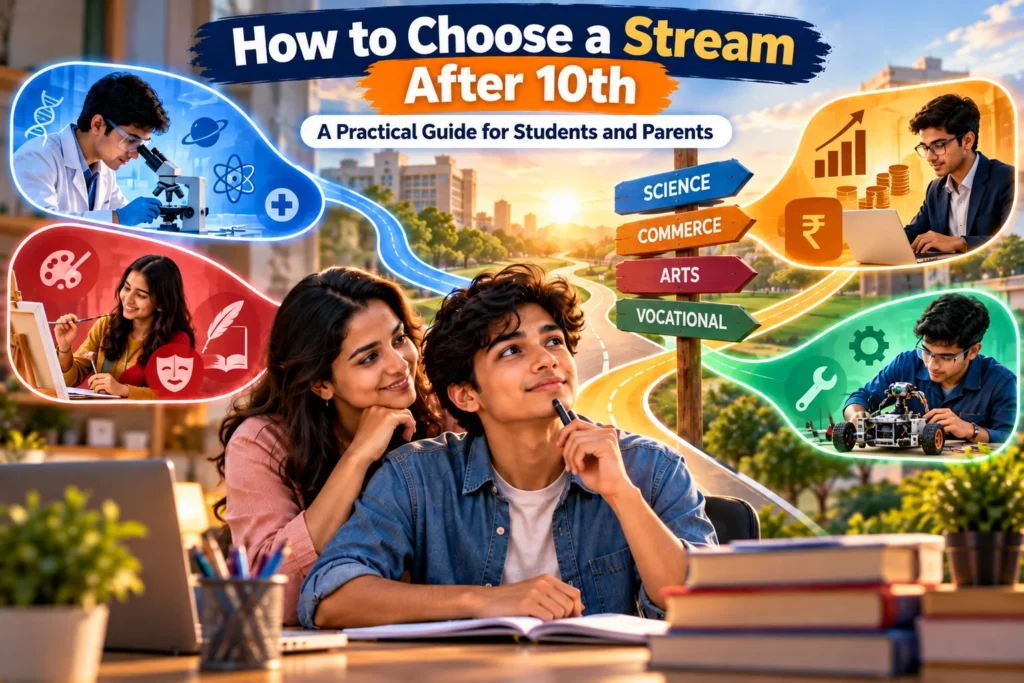
Class 10 results bring relief, celebration and, very quickly, a big question: which stream now? In most Indian schools, students move into Science, Commerce or Arts (Humanities) in Class 11, and this choice shapes the subjects they study for two years, the entrance exams they can take and the courses open to them after Class 12. Knowing how to choose a stream after 10th calmly and sensibly matters, because the decision is often made in a few weeks, under pressure from relatives, friends and coaching advertisements.
This guide by vidya nirbhar is for Class 10 students and their parents. We explain what each stream involves, a step by step process for choosing, how aptitude and interests fit in, what boards now allow in terms of subject flexibility, and the mistakes families commonly make. We use the Tamanna aptitude assessment developed by NCERT and CBSE as a real example of a tool designed to help students understand their strengths before choosing.
Why the Stream Choice Matters
The stream you choose in Class 11 decides your core subjects for Classes 11 and 12. These subjects, in turn, decide your eligibility for many courses and entrance exams. Engineering usually needs Physics, Chemistry and Mathematics. Medicine needs Physics, Chemistry and Biology. Chartered accountancy and many commerce degrees are easier with Accountancy and Business Studies, though not always mandatory. Many arts, law, design and management courses are open to all streams.
At the same time, the stream is not a lifelong sentence. Many students change direction after Class 12 or later. The aim is to choose a stream that suits you now and keeps sensible options open.
The Three Main Streams at a Glance
| Stream | Typical Subjects | Common Paths After Class 12 |
|---|---|---|
| Science (with Mathematics) | Physics, Chemistry, Mathematics, plus English and an elective such as Computer Science | Engineering, architecture, BSc in physical sciences, BCA, data related courses, and most commerce or arts courses |
| Science (with Biology) | Physics, Chemistry, Biology, plus English and an elective | Medicine, dentistry, AYUSH, nursing, pharmacy, life sciences, allied health |
| Commerce | Accountancy, Business Studies, Economics, English, with Mathematics or Applied Mathematics as an option | BCom, BBA, chartered accountancy and similar professional routes, economics, management, law |
| Arts or Humanities | History, Political Science, Geography, Psychology, Sociology, Economics, languages | BA programmes, law, journalism, design, social work, civil services preparation, teaching |
Step 1: Look Honestly at Your Interests
Ask yourself which subjects you enjoy, not just which ones you score in. Which chapters did you read beyond the syllabus? Which topics do you talk about with friends? Do you enjoy experiments and problem solving, understanding money and business, or reading about people, history and society? Interest keeps you going through two demanding years of Class 11 and 12.
Step 2: Look at Your Strengths and Marks
Your Class 9 and 10 marks give useful evidence, especially subject wise. Consistent strength in Mathematics and Science suggests you can handle the Science stream’s workload. Strong performance in Social Science and languages may point towards Humanities. Comfort with numbers and practical reasoning can suit Commerce. Look at patterns over two years rather than one exam, and talk to your subject teachers about what they have observed.
Step 3: Use an Aptitude Assessment
Aptitude tests measure natural abilities, such as numerical, verbal, spatial or mechanical reasoning. They do not decide your future, but they can confirm what you suspect or show strengths you had not noticed. Results are most useful when discussed with a teacher or qualified counsellor alongside your marks and interests.
Real Example: The Tamanna Aptitude Assessment by NCERT and CBSE
Tamanna, which stands for “Try And Measure Aptitude And Natural Abilities”, is an aptitude assessment developed by the National Council of Educational Research and Training (NCERT) and the Central Board of Secondary Education (CBSE) under the then Ministry of Human Resource Development. It was introduced for students of Classes 9 and 10 in CBSE affiliated schools around 2019, after pilot testing with thousands of students.
The assessment covers seven areas: language aptitude, abstract reasoning, verbal reasoning, mechanical reasoning, numerical aptitude, spatial aptitude and perceptual aptitude. It has no pass or fail result. Instead, it is meant to give students, parents and teachers information about a student’s relative strengths, to support better decisions about subjects and streams. More information is available on the NCERT Tamanna page.
The lesson from Tamanna is not that a single test should choose your stream. It is that strengths can be measured in several ways, and that a structured look at abilities, along with marks and interests, leads to better choices than following friends or popular opinion.
Step 4: Think About Possible Careers, Loosely
You do not need a fixed career at 15 or 16, but it helps to have a few broad directions. If you are strongly drawn to medicine or engineering, Science is usually necessary. If you like business, finance or accounting, Commerce fits naturally. If you enjoy law, journalism, psychology, design or public service, Humanities can be an excellent base. If you are unsure, choose a stream that keeps several of your possible paths open.
After Class 12, many degrees accept students from more than one stream. A BA, for instance, is open to students from all streams at many universities, while a BSc usually needs Science.
Step 5: Check Your School’s Options and Board Rules
Not every school offers every stream or subject combination. Before deciding, ask your school:
- Which streams and subject combinations are offered in Class 11?
- Are there minimum marks for admission to particular streams?
- Is Applied Mathematics offered as an alternative to Mathematics for Commerce and Humanities students?
- Can you take an elective from another stream, such as Psychology with Science or Computer Science with Commerce?
- Are seats limited in popular streams?
Boards and schools differ in how flexible they are. Some boards allow wide subject combinations, while many schools run fixed packages because of timetables and teacher availability. Find out early so you are not surprised during admission.
Step 6: Consider Workload and Coaching Pressure
The Science stream, particularly when combined with coaching for competitive exams, can be demanding. Commerce and Humanities have their own challenges, including large amounts of reading, writing and conceptual understanding. Be realistic about how much time and energy you can invest, and avoid choosing a stream only because it is seen as the “toughest” or most prestigious.
If You Are Good at Everything, or Nothing Stands Out
Some students score well across all subjects and enjoy most of them. Others feel that no subject stands out. Both situations are common. If you are strong across the board, think about which kind of work you would happily do for long hours: solving numerical problems, analysing business situations, or reading and writing about ideas. If nothing stands out yet, pick a stream that keeps the widest range of options open for you, and use Classes 11 and 12 to learn more about yourself.
Science with Mathematics keeps many doors open, because its students can later move to commerce, arts, management or law courses. However, it is only a good choice if you can manage its workload without losing interest. Commerce with Mathematics also keeps a wide range of business, economics and professional options available.
Vocational Subjects and Other Options
Many boards now offer vocational or skill subjects in Classes 11 and 12, such as information technology, retail, tourism, healthcare or financial markets, alongside academic subjects. These can give practical exposure and, in some cases, a head start in a related field. Polytechnic diplomas after Class 10 are another route for students interested in technical careers, with the option of lateral entry into engineering degrees later, subject to rules.
Whatever you choose, look ahead to the degrees you may want. A BCom is the natural next step for many commerce students, while science students often move to engineering, medicine or a BSc, and arts students to a BA, law or design.
Talking It Through as a Family
Parents bring experience and care, and their concerns about stability and cost are genuine. Students bring self knowledge about what they enjoy and can sustain. The best decisions come from open conversation. Share your marks, interests, aptitude results and research. Discuss two or three options rather than one. If disagreements persist, meet a qualified counsellor together for a neutral view.
Comparing the Streams on Key Factors
| Factor | Science | Commerce | Arts or Humanities |
|---|---|---|---|
| Workload | Heavy, especially with entrance coaching | Moderate to heavy, with numerical and theory work | Reading and writing intensive |
| Flexibility later | High; can move to commerce or arts courses after Class 12 | Good for business, law and arts courses | Good for arts, law, design, media and management |
| Key entrance exams | JEE, NEET, CUET | CUET, CA Foundation, management tests | CUET, CLAT, design tests |
| Best suited for | Students strong in maths and science | Students interested in business and numbers | Students interested in people, society and ideas |
Common Mistakes Families Make
- Choosing Science by default because it is seen as more prestigious
- Following friends into the same stream
- Ignoring clear evidence of the student’s interests and strengths
- Assuming Humanities is only for students with low marks
- Not checking which subject combinations the school actually offers
- Deciding in a hurry without any discussion with teachers or counsellors
Frequently asked questions
How do I choose the right stream after Class 10?
Look at your interests, your subject wise marks over Classes 9 and 10, and any aptitude assessment results. Think about broad career directions, check the subject combinations your school offers, and discuss options with parents and teachers before deciding. Choose a stream that suits you and keeps options open.
Is Science the best stream after Class 10?
Not for everyone. Science suits students who enjoy and are strong in mathematics and science, and it is needed for engineering and medicine. Commerce and Humanities lead to many strong careers too. The best stream is the one that matches your interests and strengths.
Can I change my stream after Class 11?
Some schools allow a change early in Class 11, subject to seat availability and board rules, but it becomes harder later. After Class 12, many degree courses accept students from different streams. Ask your school about its policy if you are unsure.
What is the Tamanna aptitude test?
Tamanna, or Try And Measure Aptitude And Natural Abilities, is an aptitude assessment developed by NCERT and CBSE for Classes 9 and 10. It measures seven areas such as numerical, verbal and spatial aptitude and has no pass or fail result.
Do I need Mathematics for Commerce?
Not always, but it helps. Mathematics or Applied Mathematics is useful for economics, chartered accountancy and many business degrees, and some universities require it for certain courses. Check the eligibility of courses you may want after Class 12 before dropping mathematics.
Is Humanities a good choice for bright students?
Yes. Humanities leads to careers in law, civil services, journalism, psychology, design, research, teaching and public policy. Many high scoring students choose it because of genuine interest. Strong reading, writing and analytical skills are highly valued in these fields and many others.