
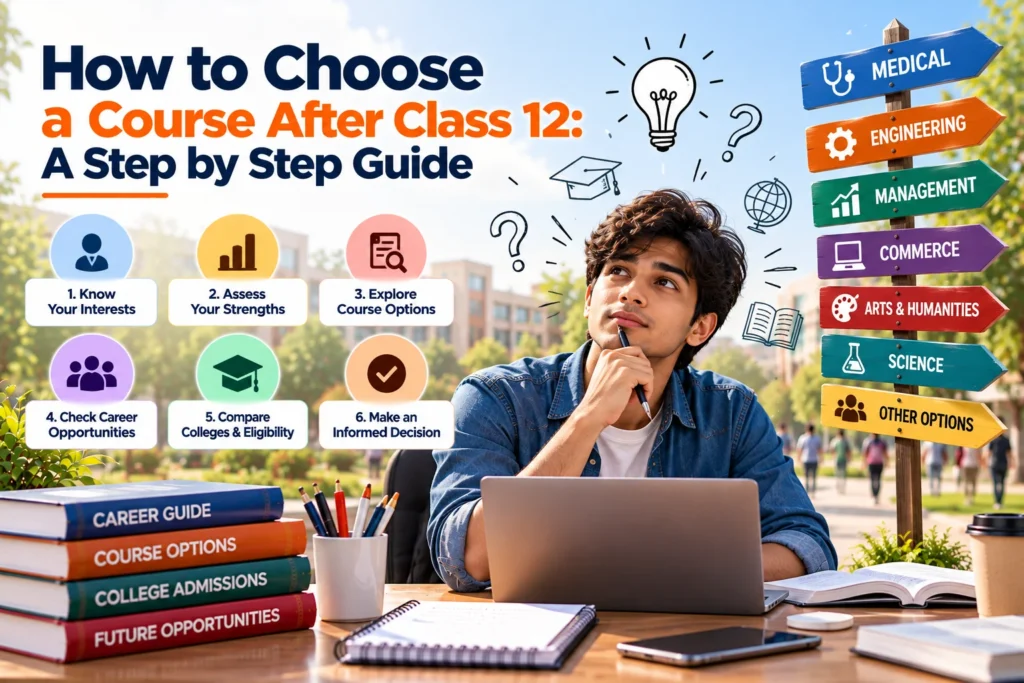
The months after Class 12 can feel overwhelming. Friends are talking about entrance exams, relatives are suggesting careers, and coaching advertisements promise success in every field. In the middle of all this, you have to decide what you will study for the next three to five years. Knowing how to choose a course carefully makes this decision calmer and more sensible. A good choice does not need to be perfect, but it should match your interests, your strengths, your circumstances and the kind of future you want to work towards.
This guide by vidya nirbhar is for Class 12 students and their parents across science, commerce and arts streams. We set out a practical process for choosing a course, explain the main course options after each stream, show how the National Education Policy 2020 has added flexibility, and list the mistakes students often make. We use Savitribai Phule Pune University as a real example of how a large state university offers many course paths through its departments and affiliated colleges.
Step 1: Understand Yourself First
Every good course decision starts with honest self assessment. Ask yourself:
- Interests: which subjects do you enjoy reading about even when no exam is coming?
- Strengths: where have your marks and effort been consistently strong?
- Working style: do you prefer numbers, writing, practical work, people or creative tasks?
- Values: is stability, income, social impact, creativity or independence most important to you?
- Practical limits: budget, location, family responsibilities and how far you can travel.
Write your answers down. Patterns often become clear on paper. If you are unsure, aptitude and interest assessments offered by schools or career counsellors can help, though they should guide rather than decide your choice.
Step 2: Know the Course Options After Your Stream
| Stream in Class 12 | Common Course Options |
|---|---|
| Science with Mathematics | BTech or BE, BSc in Physics, Mathematics, Computer Science or Statistics, BCA, BArch, BSc Data Science, and many commerce or arts courses |
| Science with Biology | MBBS, BDS, BAMS and other AYUSH courses (through NEET UG), BSc Nursing, BPharm, BSc in life sciences, allied health sciences |
| Commerce | BCom, BBA, BMS, BCom with specialisations, chartered accountancy and related professional routes, economics |
| Arts or Humanities | BA in subjects such as English, History, Political Science, Psychology, Economics or Sociology, BJMC, BSW, BFA, integrated law |
| Any stream | Integrated law (through CLAT or university tests), hotel management, design, BA programmes, many vocational degrees |
Many courses accept students from more than one stream. A BA in Economics, for example, may accept students from science, commerce or arts, subject to the university’s eligibility rules. Check eligibility for each course you consider.
Step 3: Research Where Each Course Leads
For every course on your list, find out:
- What subjects are taught in each year, using the university syllabus.
- What jobs, further studies or professional routes graduates usually take.
- Whether the course leads directly to a profession or is a foundation for further study.
- Which entrance exams or competitive exams connect to it.
- How long it takes to become employable, including postgraduate study or professional qualifications.
Talk to people currently studying the course or working in the field. Their experience often tells you more than brochures. Ask them what they wish they had known before starting.
Step 4: Match Courses With Entrance Exams and Eligibility
Many courses require entrance tests. Engineering admissions use JEE Main, JEE Advanced or state CETs. Medicine uses NEET UG. Central universities mostly use CUET UG for undergraduate programmes. Law uses CLAT or university tests. Design and architecture have their own tests. Check dates early, because registration windows for some exams open months before Class 12 board results.
Also check subject requirements. Some programmes require Mathematics in Class 12, others require Biology, and some require minimum marks in specific subjects. Missing one subject can rule out an entire course, so check this before you commit.
Step 5: Consider Cost, Duration and Location
A course is a financial decision as well as an academic one. Compare tuition, hostel, living and material costs across options. Professional courses in private institutions can be expensive, while many government colleges offer degree programmes at much lower fees. Duration matters too: a three year degree, a four year honours programme and a five year integrated course have different total costs and timelines.
Scholarships, fee waivers and education loans can make expensive courses more manageable. Factor them in only when you are reasonably confident of receiving them.
Step 6: Build a Shortlist and a Backup Plan
Once your research is done, narrow your options to two or three courses that suit you well. For each course, list the entrance exams, application dates and institutions you will apply to. Then build a backup plan. If your first choice depends on a highly competitive entrance exam, make sure you also apply for a second course or a set of institutions where admission is more likely.
A backup plan is not a sign of low confidence. It protects you from losing a year because of one exam result or one counselling round. Many students who take a related course as a backup still reach their goals through postgraduate study, lateral entry or a later attempt at an entrance exam.
Short Term Trends vs Long Term Fit
Every few years, certain courses become fashionable because of news about high salaries or new industries. Demand in a field can change during the three to five years you spend studying. Rather than choosing a course only because it is popular now, look for one that fits your long term interests and builds skills that transfer across jobs, such as analysis, communication, problem solving and technical ability. A course you enjoy is also one in which you are more likely to perform well, which itself improves your options.
How NEP 2020 Has Changed Course Choices
The National Education Policy 2020, published by the Ministry of Education, introduced more flexibility in undergraduate study. Under UGC’s Curriculum and Credit Framework for Undergraduate Programmes, released in December 2022, many universities now offer four year undergraduate programmes with multiple entry and exit options. Students can exit with a UG certificate after the first year (40 credits) or a UG diploma after the second year (80 credits), each with a vocational component, or continue to a bachelor’s degree and, in the fourth year, an honours or honours with research degree.
The framework also encourages major and minor subjects, interdisciplinary courses and skill components. This means your choice after Class 12 is not as rigid as it once was. You may be able to add a minor in a different field or switch emphasis later. Implementation varies by university, so check how the universities on your list have adopted the framework.
Real Example: Course Paths at Savitribai Phule Pune University
Savitribai Phule Pune University, established on 10 February 1949, is a public state university in Pune, Maharashtra. It has a large affiliating system, with several hundred affiliated colleges across Pune and nearby districts offering undergraduate and postgraduate courses, alongside the university’s own teaching departments on its Ganeshkhind campus. In NIRF 2024, it was ranked 23rd in the university category.
For a Class 12 student, a university of this size shows how many course paths are available within one system. Affiliated colleges offer conventional degrees such as BA, BCom and BSc, as well as professional courses such as engineering, pharmacy, management and law, depending on the college. The university’s departments offer many postgraduate programmes. A student who starts with a BSc in an affiliated college could later move to a postgraduate department of the same university or elsewhere. Each course has its own eligibility, admission route and fees for the year, so students should check the university’s and individual colleges’ official notices.
You can view Savitribai Phule Pune University on VidyaNirbhar to see its details alongside other universities. The broader lesson is that a large state university can offer a wide range of affordable options, and your course choice can be paired with a suitable college within the same system.
Professional Courses vs Conventional Degrees
| Aspect | Professional Courses | Conventional Degrees |
|---|---|---|
| Examples | Engineering, medicine, law, pharmacy, architecture | BA, BSc, BCom |
| Entrance tests | Usually required | Often merit based or CUET |
| Cost | Often higher | Often lower, especially in government colleges |
| Career link | Direct link to a profession | Broad foundation; careers often need further study or skills |
| Flexibility | More specialised | More flexible for changing direction |
Neither path is automatically better. A conventional BCom combined with a professional qualification, for example, can lead to a strong career, while a professional course chosen without interest can lead to frustration.
Talking to Parents About Your Choice
Course choices often involve family discussion. Parents bring experience and concern for your future, and their worries about cost and stability are real. Share your research with them: the syllabus, career paths, costs and examples of people who have done well in the field. A calm, informed conversation usually works better than a sudden announcement. If you disagree, consider meeting a qualified career counsellor together.
Common Mistakes Students Make
- Choosing a course only because friends are choosing it
- Picking a field for its reputation without checking interest or aptitude
- Ignoring entrance exam dates and subject requirements
- Not reading the syllabus before deciding
- Underestimating the total cost and duration
- Assuming one choice fixes your whole career
- Relying only on coaching centre or agent advice
Conclusion
Learning how to choose a course after Class 12 comes down to a clear process: understand yourself, list courses open to you, research where they lead, check entrance exams and eligibility, and weigh cost and duration. NEP 2020 has made undergraduate study more flexible, and large universities such as Savitribai Phule Pune University show how many paths exist within one system. vidya nirbhar prepares these guides so that students and parents can make this choice calmly and with good information. You can compare courses, colleges and universities on VidyaNirbhar as you finalise your plan.
Frequently asked questions
How do I choose the right course after Class 12?
Start by assessing your interests, strengths and values. List courses open to your stream, research their syllabus and career paths, check entrance exams and eligibility, and compare costs and duration. Talk to students and professionals in the field before you finalise your choice.
Can I choose a course outside my Class 12 stream?
Often, yes. Many courses such as BA programmes, BBA, law, design and hotel management accept students from any stream. Some courses require specific subjects, such as Mathematics or Biology. Check the eligibility rules of each course and university before applying.
Is a professional course better than a regular degree?
Not necessarily. Professional courses link directly to a profession but cost more and are more specialised. Regular degrees are flexible and affordable, and combined with further study or skills they can lead to strong careers. The right choice depends on your interests and goals.
What is the four year undergraduate programme under NEP 2020?
Under UGC's framework, many universities offer four year undergraduate programmes with multiple exits. Students can leave with a certificate after one year, a diploma after two years, a degree after three years, or continue to an honours or research degree in the fourth year.
What if I choose the wrong course?
It is not the end of the road. Under NEP 2020 frameworks, some universities allow exits with credentials and later re-entry. You can also change direction through postgraduate study, professional courses or skill programmes. Act early if you feel the course does not suit you.
Should I take a career aptitude test?
An aptitude or interest test can help you think about options you had not considered. Treat results as one input, alongside your marks, interests, values and conversations with people in the field. A qualified counsellor can help you interpret the results sensibly.