Knowing how to check UGC recognition before admission can save you years of effort and a lot of money. A university in India can award valid degrees only if it has been set up under a central or state Act, or declared a deemed to be university, and appears in the University Grants Commission (UGC) lists. The good news is that verification takes only a few minutes on official websites, and you do not need an agent or a paid service to do it.
This guide by VidyaNirbhar is for Class 12 students, parents, graduates applying for postgraduate study, working professionals choosing distance or online degrees, and international students considering India. We explain what UGC recognition actually means, the official lists to check, how to spot fake universities, how to verify distance and online programmes, and what extra approvals professional courses need. We also walk through a real example of a fake university whose name closely resembles a top institute.
What Does “UGC Recognised” Mean?
The University Grants Commission was set up under the UGC Act, 1956 to coordinate and maintain standards in university education. Under Section 22 of the Act, only a university established by a central, state or provincial Act, an institution deemed to be a university under Section 3, or an institution specially empowered by Parliament can award degrees.
When people say a university is “UGC recognised” or “UGC approved”, they usually mean it appears in one of the UGC’s official lists of universities. These lists are grouped into four main categories:
- Central universities: Created by Acts of Parliament
- State universities: Created by state legislatures
- State private universities: Created under state Acts on the application of private sponsoring bodies
- Deemed to be universities: Declared by the Central Government under Section 3 of the UGC Act
A point many students miss: UGC recognises universities, but it does not separately “approve” every course in regular mode. However, degree names must follow the UGC Specification of Degrees, and professional courses need approval from their own councils. Distance and online programmes need separate UGC recognition every year.
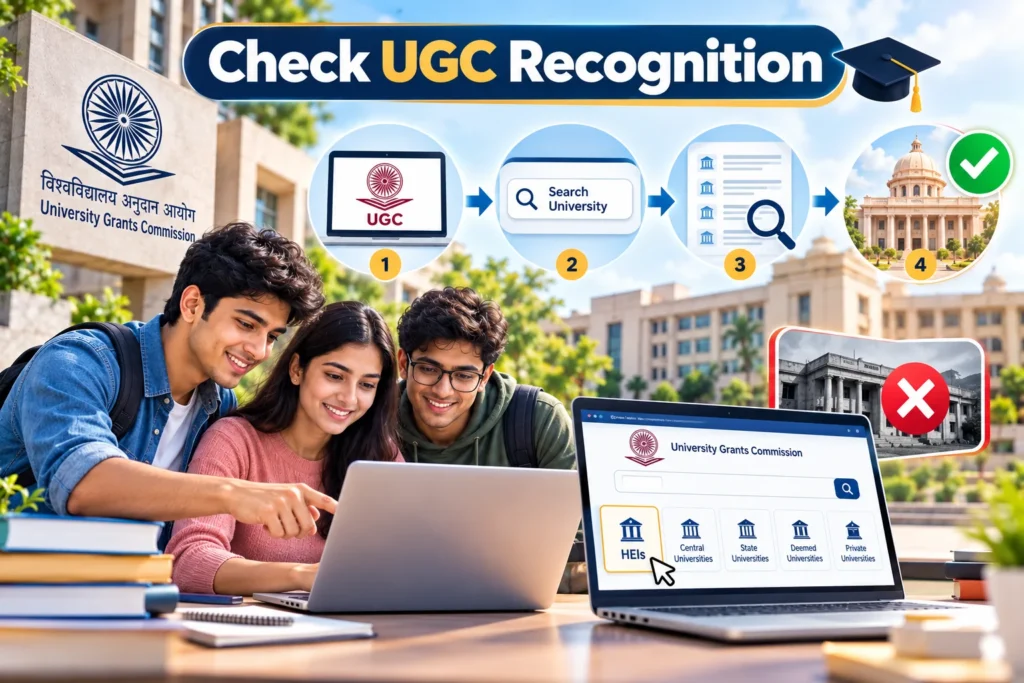
How to Check UGC Recognition: Step by Step
- Go to the official UGC website: Type ugc.gov.in directly into your browser rather than clicking links from advertisements.
- Open the universities section: UGC publishes separate lists of central, state, private and deemed to be universities, along with a consolidated list.
- Search for the exact name: Match the full name and location carefully. Many unrecognised institutions use names that look similar to real universities.
- Check the category: Note whether it is central, state, private or deemed. This tells you which rules apply, including where it can run campuses.
- Check the fake universities list: UGC publishes a list of self styled institutions that are not entitled to award degrees. Make sure your institution is not on it.
- Verify the programme: For distance or online study, check the UGC Distance Education Bureau list for your admission year. For professional courses, check the relevant council’s approved list.
- Cross check the university’s website: A genuine university usually displays its establishing Act or UGC notification and has an official domain, often ending in .ac.in or .edu.in.
The UGC consolidated list of universities is a useful starting point, but always check the latest category wise lists as well, since new universities are added over time.
Example check for a private university
Suppose you are considering a state private university in Gujarat. Open the UGC list of private universities, go to the Gujarat section and search for the name. Nirma University in Ahmedabad, for instance, appears there as a state private university. Next, check that the programme you want has any required council approval, and then look up its NAAC grade. The whole process takes about ten minutes.
How to Spot a Fake University
The UGC regularly updates its list of fake universities. According to reports on the UGC’s list published in early 2026, it named 32 such institutions, with Delhi accounting for the largest share. The number has risen from 22 in late 2025, showing that the problem is ongoing.
Common warning signs
- Names that copy or closely resemble well known institutions, or use words like “United Nations”, “National” or “International” to sound official
- Promises of degrees without exams, in a few months, or “backdated” degrees
- No establishing Act or UGC notification mentioned on the website
- Admission through agents who collect fees in personal bank accounts
- Study centres in many states for a state or private university, which UGC rules generally do not allow
- Very low fees for professional courses such as engineering or law in distance mode, which UGC does not permit
Real Example: A Fake Institute with a Familiar Name
One entry on the UGC’s fake universities list for Delhi is an institution called the “Indian Institute of Science and Engineering”. The name sounds very close to the Indian Institute of Science in Bengaluru, which is a genuine deemed to be university and has ranked first in the NIRF university category since the rankings began.
A student or parent glancing quickly at a brochure might assume a link between the two. In reality, the UGC has publicly listed the Delhi entity as not entitled to award degrees. Any “degree” from such an institution would not be valid for jobs, competitive exams or higher studies.
The lesson is simple. Never rely on the name alone. Search for the exact name in the UGC lists, confirm the location, and check whether it appears on the fake universities list. If anything looks unclear, write to the university’s official email and ask for its establishing Act or UGC notification.
Checking Distance and Online Programmes
Distance and online programmes need an extra step. Under the UGC (Open and Distance Learning Programmes and Online Programmes) Regulations, 2020, the UGC’s Distance Education Bureau recognises institutions and programmes for specific academic sessions.
- Visit deb.ugc.ac.in and open the list of recognised or entitled institutions for the relevant session.
- Check that your university and the exact programme are listed for the session in which you enrol.
- Confirm territorial jurisdiction. State and private universities can generally offer ODL only within their state.
- Remember that some programmes, including engineering, medicine, law, nursing, pharmacy and architecture, cannot be offered in ODL or online mode at all.
Degrees from recognised ODL and online programmes are treated as equivalent to regular degrees under Regulation 22 of the 2020 regulations, but only when recognition is valid for your session.
Checking Approvals for Professional Courses
Being a UGC listed university is necessary but not enough for professional programmes. Each field has a statutory body whose approval matters:
| Programme | Approval Needed From |
|---|---|
| Engineering, technology, management (at certain institutions), MCA | All India Council for Technical Education (AICTE) |
| MBBS, MD and other medical programmes | National Medical Commission (NMC) |
| Law (LLB) | Bar Council of India (BCI) |
| BEd, DElEd and other teacher education programmes | National Council for Teacher Education (NCTE) |
| Pharmacy | Pharmacy Council of India (PCI) |
| Nursing | Indian Nursing Council (INC) and state nursing council |
| Architecture | Council of Architecture (COA) |
| Dental | Dental Council of India (DCI) |
A law degree without BCI approval, for instance, may not let you enrol as an advocate. Always check the council’s approved list for your admission year. If you are planning teacher education, our page on the BEd course explains the programme and approval basics.
Other Useful Checks: NAAC, NIRF and 12(B)
UGC recognition confirms legality, not quality. To judge quality, look at:
- NAAC accreditation: The National Assessment and Accreditation Council grades institutions. Check the grade and validity period on the NAAC website.
- NIRF ranking: The Ministry of Education’s National Institutional Ranking Framework publishes annual rankings. The 2025 edition was released on 4 September 2025.
- 12(B) status: Universities and colleges listed under Section 12(B) of the UGC Act are eligible for central grants. This is not required for recognition, but it shows the UGC has examined the institution further.
A Note on Regulatory Changes
In December 2025, the Viksit Bharat Shiksha Adhishthan Bill was introduced in Parliament to replace the UGC, AICTE and NCTE with a single higher education regulator. The bill was referred to a Joint Parliamentary Committee. Until a new law is passed and notified, the UGC continues to publish university lists. If the system changes, recognition checks will move to the new regulator’s website, so keep an eye on official announcements.
Common Mistakes to Avoid
- Trusting a “UGC approved” logo on a website without checking the UGC list yourself
- Assuming a campus in your city is genuine because the parent university is real. Off campus centres need separate approval.
- Checking only the university and ignoring council approval for professional programmes
- Relying on last year’s distance education recognition for this year’s admission
- Paying fees to agents instead of through the university’s official portal
What to Do If You Already Joined an Unrecognised Institution
If you find out that your institution is on the fake list or lacks recognition, stop paying further fees and collect all receipts and documents. Inform your parents or guardian, and file a complaint with the UGC through its official complaint channels and with local police if fraud is involved. Then look for admission in a recognised university for the next session. Some universities may allow you to start afresh, but credits from an unrecognised institution are generally not transferable.
Conclusion
Learning how to check UGC recognition is one of the simplest ways to protect your education. Search for the exact university name on the official UGC lists, confirm it is not on the fake universities list, verify distance or online programmes on the DEB website, and check council approvals for professional courses. Then use NAAC and NIRF to judge quality. VidyaNirbhar prepares these guides so families can make safe admission decisions. You can compare recognised universities and their courses on VidyaNirbhar before you apply.
Frequently asked questions
Where can I find the official list of UGC recognised universities?
The official lists are on the UGC website, ugc.gov.in, under the universities section. UGC publishes separate lists for central, state, private and deemed to be universities, along with a consolidated list and a list of fake universities. Always use the official website instead of third party lists.
Does UGC approve individual courses?
For regular courses, UGC recognises the university rather than approving each course, though degree titles must follow UGC's Specification of Degrees. Distance and online programmes need specific UGC DEB recognition each session. Professional courses also need approval from councils such as AICTE, NMC, BCI, NCTE or PCI.
Is a degree from a fake university valid?
No. Institutions on the UGC fake universities list are not empowered to award degrees, so their certificates are not valid for jobs, competitive exams or higher studies. If you have enrolled in one, stop further payments, keep your records and seek admission in a recognised university.
How do I check if a distance education programme is recognised?
Visit the UGC Distance Education Bureau website, deb.ugc.ac.in, and check the list of recognised or entitled institutions and programmes for your admission session. Confirm the exact programme name and that the university's territorial jurisdiction covers your location before you pay fees.
Are deemed universities UGC recognised?
Yes, if they appear on the UGC's list of deemed to be universities. Their status is granted by the Central Government under Section 3 of the UGC Act on UGC's advice. Check that the specific campus you plan to join is approved, since off campus centres need separate approval.
Is UGC recognition enough for a foreign university campus in India?
Foreign higher education institutions setting up campuses in India must follow UGC's regulations for foreign university campuses, notified in 2023. Check that the campus has UGC approval under these rules and confirm how degrees will be awarded and recognised before enrolling.