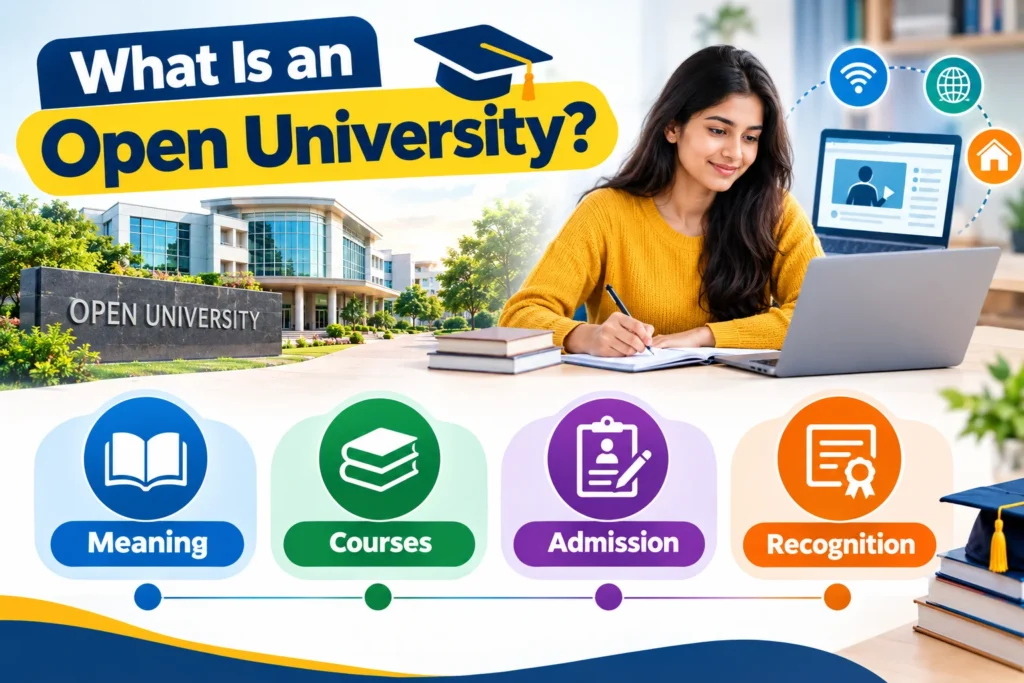
An open university is a university that teaches mainly through open and distance learning (ODL), so students study from home with printed or digital study material, online resources and occasional counselling sessions instead of attending daily classes. If you are wondering what is open university in the Indian context, the short answer is a recognised university, set up by Parliament or a state legislature, whose main job is to make higher education available to people who cannot join a regular campus.
This guide by Vidya Nirbhar is for working professionals, homemakers, students in remote areas, people who left studies midway and anyone comparing regular and distance degrees. We explain how open universities work, which courses they can and cannot offer, how admission and exams happen, whether their degrees are valid for jobs, and what to check before you enrol. We also look at IGNOU in detail as a real example.
What Is an Open University? The Simple Meaning
The word “open” refers to flexibility in entry, pace and place. Open universities usually have relaxed entry conditions, no upper age limit, and admission without a competitive entrance test for most programmes. Students can study while working and often get extra time to finish a programme.
In India, open universities are established by law. The Indira Gandhi National Open University (IGNOU) was created by an Act of Parliament in 1985 and is a central university. Dr. B.R. Ambedkar Open University in Hyderabad, set up in 1982, is recognised as India’s first open university. Many states have their own state open universities created by state Acts.
Open universities are regulated by the University Grants Commission through its Distance Education Bureau (DEB), under the UGC (Open and Distance Learning Programmes and Online Programmes) Regulations, 2020. The UGC Distance Education Bureau website publishes the year wise list of institutions and programmes that are recognised for ODL and online delivery.
How an Open University Works
Teaching in an open university is quite different from a regular college. Here is how a typical programme runs:
- Self learning material: Students receive study material, now usually as e-books and online content, designed for self study.
- Learner support centres: Regional centres and study centres arrange counselling sessions, practicals where needed, and help with administrative work.
- Assignments: Most courses require assignments that carry marks and must be submitted before the term end exam.
- Term end examinations: Exams are held at designated centres, typically twice a year.
- Credit system: Programmes are built on credits, and students can often take longer than the minimum duration to finish.
Because you study largely on your own, open learning suits people who are disciplined and can manage their time. Students who need regular classroom guidance may find it harder.
Open university vs regular university
| Point | Open University | Regular University |
|---|---|---|
| Attendance | No daily classes. Occasional counselling sessions. | Regular classes with attendance rules |
| Admission | Usually without entrance test for most programmes | CUET, entrance exams or merit lists |
| Age limit | Usually none | Generally none for UG, but most students are recent school leavers |
| Fees | Usually lower | Varies, generally higher due to campus costs |
| Pace | Flexible, with extended time to complete | Fixed semester schedule |
| Campus life | Very limited | Full campus experience, clubs and placements |
Courses Offered by Open Universities
Open universities offer certificates, diplomas, undergraduate degrees, postgraduate degrees and postgraduate diplomas in many subjects. Common programmes include BA, BCom, BSc in some subjects, MA, MCom, BBA, MBA, BCA, MCA, library science and education related programmes. If you are considering an arts degree in this mode, our page on the BA course explains common subject options.
Programmes that cannot be offered in ODL mode
According to the UGC DEB, the following cannot be offered through ODL or online mode: engineering, medical, physiotherapy, occupational therapy, paramedical disciplines, pharmacy, nursing, dental, architecture, law, agriculture, horticulture, hotel management, catering technology, culinary sciences, aircraft maintenance, visual arts, sports, MPhil and PhD.
In August 2025, UGC also stopped ODL and online admissions, from the July 2025 session, in programmes governed by the National Commission for Allied and Healthcare Professions Act, 2021. Reported examples include psychology, microbiology, food and nutrition science, biotechnology and clinical nutrition and dietetics. If an advertisement offers any of these in distance mode, treat it as a warning sign and verify with UGC.
Admission Process in Open Universities
Admission is usually simple, but details differ by university and programme.
- Check the programme eligibility in the university’s prospectus. For a bachelor’s degree, this is usually Class 12 or equivalent.
- Confirm the programme is listed as recognised by UGC DEB for the current academic session.
- Register on the university’s official admission portal and fill in personal and academic details.
- Upload scanned documents such as mark sheets, photo ID, photograph, signature and category certificate if applicable.
- Pay the programme fee online. Some universities allow semester wise or year wise payment.
- Download the confirmation and keep track of your enrolment number, study material and assignment deadlines.
Most open universities admit students without an entrance test, but some programmes, especially in education or management, may have their own entrance exam or additional eligibility conditions. Admission cycles vary. IGNOU, for example, generally runs January and July sessions.
Are Open University Degrees Valid?
Yes, when the university and programme are recognised by UGC for your admission year. Regulation 22 of the UGC ODL and Online Programmes Regulations, 2020 states that degrees at undergraduate and postgraduate level, along with diplomas and certificates, awarded through ODL or online mode by recognised institutions shall be treated as equivalent to corresponding awards through conventional mode.
Recognition is not permanent, though. UGC DEB grants recognition institution wise and programme wise for specific academic years. A programme that was recognised in one year may not be recognised in another. This is why students should check the DEB list for the exact session in which they take admission.
Open university degrees are generally accepted for government jobs, competitive exams such as UPSC and state PSC exams, and higher studies, provided recognition is in order. Some employers or regulatory bodies may set their own conditions for specific posts, so read job notifications carefully.
Real Example: Indira Gandhi National Open University (IGNOU)
IGNOU is the most widely known open university in India. It was established on 20 September 1985 under the Indira Gandhi National Open University Act, 1985, passed by Parliament, and it appears on the UGC list of central universities.
IGNOU reports a very large student base. Publicly available figures put its enrolment at around 3 million learners as of 2024. Its network includes around 67 regional centres and more than 2,000 learner support centres in India, along with overseas study centres. It offers over 300 programmes across 21 schools of studies and holds an A++ grade from NAAC.
For most programmes, IGNOU admits students without an entrance test, through its online admission portal. Students receive study material, submit assignments and appear for term end examinations at designated centres. Fees are generally modest compared with regular universities, though exact fees differ by programme and are published in the current prospectus.
The lesson from IGNOU is that the open learning model can work at very large scale and provide recognised degrees at low cost. The trade off is limited classroom contact and campus experience, so success depends heavily on self discipline and regular study.
State Open Universities in India
Several states run their own open universities, which often teach in the regional language as well as English. Examples include Yashwantrao Chavan Maharashtra Open University in Nashik, Karnataka State Open University in Mysuru, Netaji Subhas Open University in Kolkata, Uttar Pradesh Rajarshi Tandon Open University in Prayagraj and Tamil Nadu Open University in Chennai. In Gujarat, Dr. Babasaheb Ambedkar Open University in Ahmedabad serves learners across the state.
Under UGC rules, a state open university generally operates within its state’s territory. A central open university like IGNOU can operate across India. Before joining a state open university from another state, check whether its jurisdiction and recognition cover you.
Who Should Consider an Open University?
Open learning tends to work well for working professionals who need a degree for promotion, people preparing for government exams who want a recognised graduation alongside, homemakers returning to studies, and learners in areas without a good college nearby. Telangana’s Dr. B.R. Ambedkar Open University, for example, has served such learners since 1982. It is a weaker fit for students who want lab based science, campus placements or a professional licence.
Advantages and Limitations of Open Universities
Advantages
- Study while working or managing family responsibilities
- Low fees compared with most regular programmes
- No upper age limit and usually no entrance test
- Flexible pace with extended time to complete
- Access for learners in remote areas
Limitations
- Limited interaction with teachers and classmates
- Little or no campus placement support
- Requires strong self discipline and time management
- Not available for many professional courses
- Recognition must be checked year by year
Common mistakes to avoid
- Enrolling through agents who promise “fast track” degrees or guaranteed passing
- Joining programmes advertised through franchise study centres. UGC prohibits franchising of ODL programmes.
- Assuming a programme is recognised because it was recognised in an earlier year
- Missing assignment deadlines, which can stop you from appearing in exams
Conclusion
An open university is a recognised university that teaches mainly through open and distance learning, giving flexible access to degrees without daily classes or entrance tests in most programmes. IGNOU and the state open universities serve millions of learners at modest cost, and their degrees are equivalent to regular ones when UGC recognition is in place for your admission year. Before enrolling, check the UGC DEB list, confirm the programme is allowed in ODL mode and plan your study time realistically. Vidya Nirbhar prepares these guides to help learners choose with confidence. You can compare open universities and their programmes on VidyaNirbhar before you apply.
Frequently asked questions
Is an open university degree equal to a regular degree?
Yes, if the university and programme are recognised by UGC for your admission year. Under Regulation 22 of the UGC ODL and Online Programmes Regulations, 2020, degrees awarded through ODL by recognised institutions are treated as equivalent to conventional degrees. Always verify recognition on the UGC DEB website.
Is there an age limit for admission to an open university?
Open universities usually do not have an upper age limit for admission. You only need to meet the minimum educational qualification for the programme, such as Class 12 for a bachelor's degree. Some specific programmes may have additional eligibility conditions, so read the prospectus for the course you choose.
Can I do an open university course along with a regular degree?
UGC guidelines issued in 2022 allow students to pursue two academic programmes at the same time under certain conditions, including one in physical mode and one in ODL or online mode. Both institutions and programmes must be recognised. Check the latest UGC notice and the rules of both universities before enrolling.
Can I join an open university after Class 10?
Not for a degree programme, which usually requires Class 12. However, some open universities offer certificate or preparatory programmes for learners without Class 12. For school level education, the National Institute of Open Schooling (NIOS) offers secondary and senior secondary courses that can lead to degree programmes later.
Do open universities provide placements?
Most open universities do not run regular campus placements like full time colleges. Some organise job fairs or career guidance sessions. Many learners are already working and study to improve qualifications or prepare for promotions and government exams. Do not choose an open university programme expecting campus placement support.
How can I check if an open university is recognised?
Visit the UGC Distance Education Bureau website at deb.ugc.ac.in and check the list of recognised institutions and programmes for the specific academic session. Confirm the university name, programme and session. Also check the UGC list of fake universities and avoid institutions not listed by UGC.