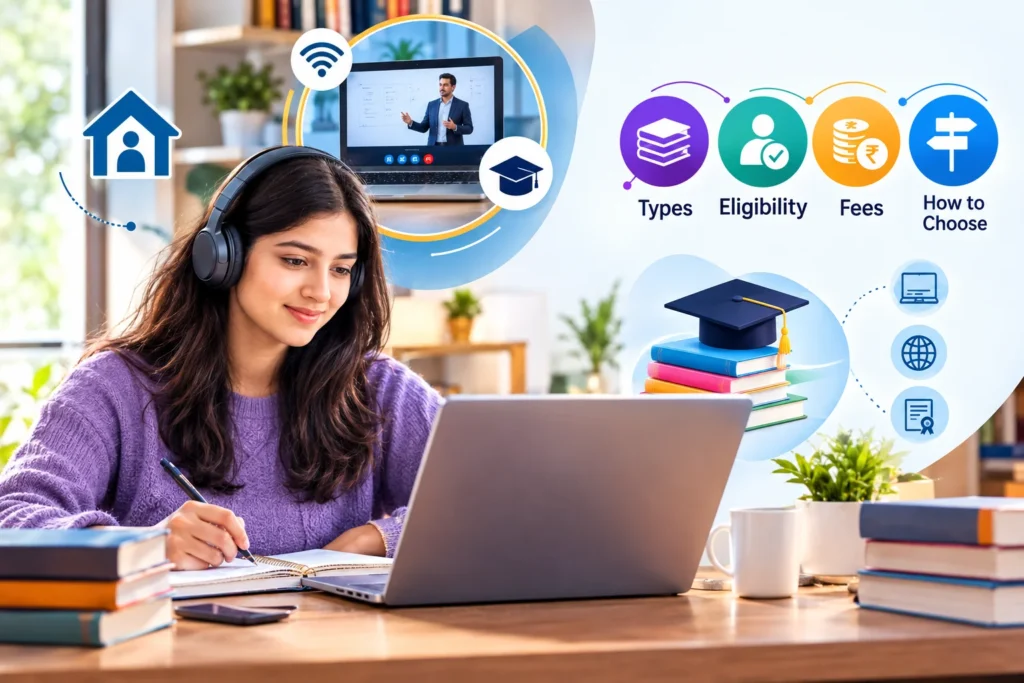
A distance learning course is a certificate, diploma or degree programme that you complete without attending regular classes on campus. You study from self learning material and online resources, submit assignments and take exams at approved centres or, for some online programmes, through proctored online tests. So when people ask what is distance learning, the practical answer is a recognised way to earn a qualification while you continue working, caring for family or living far from a college.
This guide by vidya nirbhar is for working professionals, Class 12 pass outs who missed regular admission, graduates wanting a second qualification and parents helping children weigh options. Here we focus on the courses themselves: the main types, common programmes with duration and eligibility, how a typical course is structured, what it costs, and how to pick one that is genuinely useful and properly recognised.
What Is Distance Learning? The Course Level View
Distance learning is delivered under India’s Open and Distance Learning (ODL) system and, increasingly, through approved online programmes. Both are regulated by the University Grants Commission under the UGC (Open and Distance Learning Programmes and Online Programmes) Regulations, 2020.
A distance learning course has the same broad academic structure as its regular counterpart. A distance BA, for example, has a similar minimum duration and credit requirement as a regular BA. What changes is the delivery: you learn mostly on your own, with limited contact sessions, and the university supports you through study centres, online portals and helplines.
Types of Distance Learning Courses
Certificate courses
These are short programmes, often six months to one year, in areas such as languages, computer applications, NGO management or specific skills. Eligibility is usually Class 10 or Class 12. Our page on certificate programmes lists examples offered by Indian institutions.
Diploma and postgraduate diploma courses
Diplomas usually run for one year after Class 12, while postgraduate diplomas need a bachelor’s degree and also take around one year. Popular areas include management, journalism, human resources, tourism and computer applications.
Undergraduate degrees
BA, BCom, BBA and BCA are the most common distance degrees. Some universities also offer BSc in selected subjects, though lab based science options are limited.
Postgraduate degrees
MA, MCom, MBA, MCA and MSc in some subjects are widely offered. Distance MBA and MCA programmes are popular with working professionals.
Free and credit linked online courses
The Government of India’s SWAYAM platform offers free online courses taught by faculty from Indian universities and institutions. Under the UGC Credit Framework for Online Learning Courses through SWAYAM Regulations, 2021, a university can allow students to earn up to 40 percent of the total credits in a semester through approved SWAYAM courses. You can browse current courses on the official SWAYAM portal.
Common Distance Learning Courses at a Glance
| Course | Usual Minimum Duration | Typical Eligibility | Suited For |
|---|---|---|---|
| Certificate programmes | 6 months to 1 year | Class 10 or Class 12 | Skill building, quick upskilling |
| Diploma | 1 year | Class 12 | Entry level job skills |
| BA / BCom | 3 years | Class 12 | Graduation while working, government exam eligibility |
| BBA / BCA | 3 years | Class 12, with any subject conditions set by the university | Business or IT careers |
| PG Diploma | 1 year | Bachelor’s degree | Specialisation after graduation |
| MA / MCom | 2 years | Relevant bachelor’s degree | Teaching exams, higher studies, promotions |
| MBA / MCA | 2 years | Bachelor’s degree, with any conditions set by the university | Working professionals seeking management or IT roles |
Durations shown are typical minimums. Most universities allow extra time to complete, and some programmes have specific subject or marks requirements. Always read the current prospectus.
Courses You Cannot Take Through Distance Learning
The UGC does not permit ODL or online delivery for programmes in engineering, medicine, dental, nursing, pharmacy, physiotherapy, occupational therapy, paramedical subjects, architecture, law, agriculture, horticulture, hotel management, catering, culinary sciences, aircraft maintenance, visual arts and sports. MPhil and PhD are also excluded.
From the July 2025 session, the UGC also stopped distance and online admissions in allied and healthcare programmes covered by the National Commission for Allied and Healthcare Professions Act, 2021. Reported examples include psychology, microbiology, food and nutrition science, biotechnology and clinical nutrition and dietetics. If someone offers you a distance degree in any of these, verify carefully before paying.
How a Distance Learning Course Is Structured
- Registration: You enrol online for the session and receive an enrolment number.
- Study material: Printed or digital self learning material is provided, divided into blocks and units.
- Counselling sessions: Optional or compulsory sessions at a study centre or online help clarify doubts.
- Assignments: Each course usually has assignments that form part of your marks and must be submitted before exams.
- Practicals or projects: Some courses include lab work, field work or a project.
- Term end exams: You write exams at a centre allotted by the university, typically twice a year.
- Re-registration: For multi year programmes, you re-register and pay fees each year or semester.
Plan for steady study. A common rule of thumb in credit based systems is that one credit means roughly 30 hours of study, so a four credit course needs regular effort across the term, not just last minute reading.
Real Example: Yashwantrao Chavan Maharashtra Open University
Yashwantrao Chavan Maharashtra Open University (YCMOU) in Nashik is a useful example of how a state open university structures distance courses. It was established on 1 July 1989 under the YCMOU Act, 1989 passed by the Maharashtra legislature.
The university organises its programmes through schools covering areas such as commerce and management, computer science, education, humanities and social sciences, continuing education and vocational education. Its offerings range from short certificate courses to undergraduate and postgraduate degrees, delivered through study centres across Maharashtra along with digital resources.
As a state open university, YCMOU generally serves learners within Maharashtra, in line with UGC territorial rules for state universities. The practical lesson for students is to choose a distance course from a university whose jurisdiction covers your location, and to confirm that the specific programme is listed as recognised by the UGC Distance Education Bureau for your admission year. Programme lists and fees change, so use the current prospectus rather than older brochures.
Fees for Distance Learning Courses
Distance courses are usually much cheaper than regular programmes because there are no daily classes or hostel costs. Fees are typically charged per year or semester, plus examination and registration charges. Certificate and diploma courses cost the least, while MBA and MCA programmes usually cost more than BA or BCom.
Many state open universities and IGNOU offer fee concessions for certain categories, including SC and ST learners and persons with disabilities, under applicable schemes. Exact fees are published in each university’s prospectus for the current session. Avoid relying on fee figures from coaching or agent websites.
Documents Usually Needed for Admission
- Class 10 mark sheet or certificate as proof of date of birth
- Class 12 mark sheet for undergraduate courses, or degree mark sheets for postgraduate courses
- Photo ID such as Aadhaar, along with a recent photograph and signature
- Category or disability certificate, if you are claiming a concession
- Migration certificate, if the university asks for it
Keep scanned copies ready in the format and size the admission portal asks for. Errors in names or dates between documents can delay your enrolment and later your degree.
Distance Course or Regular Course: Which Should You Pick?
Choose a regular course if you are a recent Class 12 student who can attend college, want campus placements, need lab based science, or are aiming for a professional field such as engineering, law or nursing. Regular study also gives you daily access to teachers and peers, which helps many students.
Choose a distance course if you are already working, need to stay at home for family reasons, cannot afford to relocate, or want a recognised qualification for government exams or promotion. A one year diploma through distance mode can also help you test a new field before committing to a full degree.
How to Choose the Right Distance Learning Course
- Start with your goal: Do you need a degree for a government exam, a promotion, a career switch or personal learning? This decides whether a certificate, diploma or degree makes sense.
- Check recognition: Confirm the university and programme on the UGC DEB list for your session.
- Check jurisdiction: State and private universities usually serve learners only within their own state.
- Look at the syllabus: Compare course content and electives with what employers in your field expect.
- Ask about support: Find out where the study centre and exam centre are and how doubts are handled.
- Calculate total cost and time: Include all years, exam fees and travel to exam centres.
If you are leaning towards an IT path, our page on the BCA course explains what the programme usually covers.
Common mistakes
- Choosing a course only because it is the cheapest or the shortest
- Enrolling through an agent instead of the university’s official portal
- Ignoring whether the qualification is accepted for the job or exam you are targeting
- Underestimating study time and falling behind on assignments
Conclusion
A distance learning course lets you earn a certificate, diploma or degree without regular classes, making it a practical choice for working learners and those who need flexibility. Choose a course that matches your goal, confirm UGC DEB recognition and jurisdiction for your session, and avoid programmes the UGC does not allow in distance mode. Plan your study time realistically, because self discipline decides success. Vidya nirbhar publishes these guides to help learners choose courses with confidence. You can compare universities and course options on VidyaNirbhar before you enrol.
Frequently asked questions
Is a distance learning course recognised for jobs?
Yes, if the university and programme are recognised by UGC for your admission year. Under the UGC 2020 regulations, recognised ODL and online qualifications are treated as equivalent to regular ones. Some recruitment rules for technical or professional posts may still require a regular degree or council registration, so read the job notification carefully.
Can I do a distance learning course while working full time?
Yes. Distance learning is designed for people with jobs or other responsibilities. You study at your own pace, attend occasional sessions and appear for exams on set dates. You will need to plan regular study hours and may need leave for exams and any compulsory practical sessions.
Are SWAYAM courses free?
Learning on SWAYAM is free. If you want a certificate, you usually need to register for a proctored exam, which may carry a fee. Credits from SWAYAM courses can be transferred to your degree only if your university has adopted the UGC SWAYAM credit framework and approved the course.
Can I switch from a distance course to a regular course?
Switching midway is rarely straightforward, because universities have different credit structures and admission rules. Some universities may consider lateral entry or credit transfer under their rules and the Academic Bank of Credits. Usually, it is simpler to complete your distance degree and apply for a regular postgraduate programme afterwards.
How are exams conducted in distance learning courses?
For ODL programmes, term end exams are usually held in person at exam centres allotted by the university, typically twice a year. Approved online programmes may conduct proctored online exams. Assignments and, where applicable, practicals also count towards your final marks.
Is there an entrance exam for distance learning courses?
Most distance courses admit students without an entrance exam, based only on eligibility. A few programmes, especially in management or education, may have an entrance test or additional criteria set by the university. Check the prospectus of your chosen university for the current year.