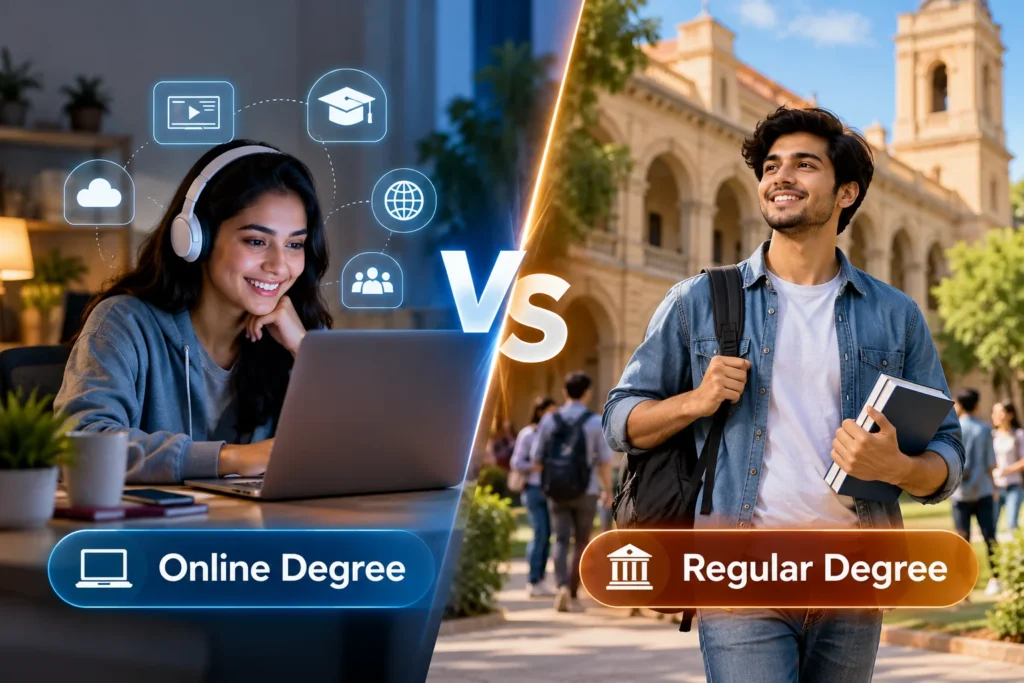
A few years ago, most families in India saw a regular, on campus degree as the only serious option. Today, recognised universities offer online degrees and open and distance learning programmes in many subjects, and working professionals, homemakers, students in remote areas and those who need to earn while studying are choosing them in large numbers. The online vs regular degree question is no longer about which one is “real”. Both can be valid. The real question is which mode fits your goals, your circumstances and the course you want, and how to make sure the programme is approved.
This guide by vidya nirbhar is for Class 12 students, graduates, working professionals and parents comparing study modes. We explain how regular, online and distance programmes differ, what UGC rules say about recognition and equivalence, which courses cannot be studied online, the pros and limitations of each mode, and how to decide. We use Dr. B. R. Ambedkar Open University in Hyderabad as a real example of a long established open university.
Three Modes of Study Explained
| Mode | How It Works | Typical Learner |
|---|---|---|
| Regular (on campus) | Daily classes on campus with in person teaching, labs and attendance rules | Students who can study full time |
| Online | Classes, study material, assessments and interaction through a digital platform, often with proctored online exams | Working learners, students needing flexibility |
| Open and distance learning (ODL) | Self study with printed or digital material, study centre support and term end exams at centres | Learners with limited time or access to campuses |
Online and ODL are related but not identical. Online programmes run mainly through a digital platform, while ODL relies more on self study material and study centres. Both are governed by UGC’s regulations for open and distance learning and online programmes.
Are Online Degrees Valid in India?
Yes, when they are offered by an institution approved by UGC for that mode and programme. Under the UGC (Open and Distance Learning Programmes and Online Programmes) Regulations, 2020, degrees awarded through approved ODL and online programmes are treated as equivalent to the corresponding degrees awarded through conventional mode. To offer online programmes, universities must meet eligibility conditions set in the regulations, such as a minimum NAAC score or a place in the NIRF university rankings, and receive UGC approval.
The approval is specific to the institution, programme and academic session. UGC’s Distance Education Bureau publishes lists of approved institutions and programmes on the UGC DEB portal. Always check this list for the session in which you plan to enrol.
Courses You Cannot Study Online or by Distance
UGC does not permit certain programmes in ODL or online mode. These include professional programmes such as engineering, medicine, dental, pharmacy, nursing, architecture, law, physiotherapy, agriculture and hotel management, among others, as listed in the regulations and later notices. In August 2025, UGC also stopped ODL and online delivery of programmes governed by the National Commission for Allied and Healthcare Professions, including subjects such as psychology, microbiology, food and nutrition science, biotechnology and clinical nutrition, from the July 2025 academic session.
If an institution advertises any of these programmes in online or distance mode, treat it as a serious warning sign and verify with UGC before paying any fee.
Online vs Regular Degree: Side by Side
| Factor | Regular Degree | Online Degree |
|---|---|---|
| Flexibility | Fixed timetable and attendance | Study at your own pace within deadlines |
| Cost | Tuition plus hostel, travel and living costs | Usually lower overall; no relocation needed |
| Interaction | Daily contact with teachers and peers | Online sessions, forums and limited live contact |
| Practical work | Labs, fieldwork and campus facilities | Limited; not suitable for lab heavy subjects |
| Campus life | Clubs, events, sports and networking | Minimal |
| Placements | Campus recruitment at many institutions | Placement support varies; often limited |
| Self discipline needed | Moderate | High |
| Recognition | Valid if the institution is recognised | Valid if UGC approved for that mode and session |
Real Example: Dr. B. R. Ambedkar Open University, Hyderabad
Dr. B. R. Ambedkar Open University in Hyderabad, Telangana, was established in 1982 as the Andhra Pradesh Open University under the Andhra Pradesh Open University Act, 1982, and was renamed in 1991 in honour of Dr. B. R. Ambedkar. It is widely described as India’s first open university, and it was set up to widen access to higher education for learners who could not attend conventional colleges.
The university offers undergraduate, postgraduate, diploma and certificate programmes through distance learning, supported by a network of study centres. Its learners include working adults, first generation learners and students in rural areas. Admission is generally less restrictive than at conventional universities, and fees are typically lower, which is part of the purpose of an open university. As with any ODL institution, students should confirm that their specific programme is approved by UGC’s Distance Education Bureau for the current session, and check fees and dates on the university’s official website.
You can view Dr. B. R. Ambedkar Open University on VidyaNirbhar. The example shows how open universities have long served learners who need flexibility, well before online degrees became common.
When a Regular Degree Is the Better Choice
- You can study full time and want a complete campus experience.
- Your subject needs labs, studios or fieldwork, such as the sciences or performing arts.
- Your course is not permitted in online or distance mode.
- You want campus placements, internships arranged by the institution and peer networks.
- You benefit from structure and daily contact with teachers.
When an Online Degree Is the Better Choice
- You are working and want to earn a degree without leaving your job.
- Family responsibilities or location make daily campus attendance difficult.
- Cost is a major concern and relocation is not affordable.
- You are self disciplined and comfortable with digital learning.
- You want a degree mainly for career progression or eligibility, and your field values skills and experience.
Common online programmes include arts, commerce and management degrees such as a BCom, BA, BBA, MBA and MCom, where recognised universities hold UGC approval.
Making Online Study Work for You
Online learners who succeed usually build habits that replace the structure a campus provides. If you choose an online degree, plan for these from the first week:
- Fixed study slots: set aside regular hours each week, such as early mornings or weekends, and protect them.
- A quiet study space: a consistent place with a reliable internet connection helps concentration.
- Active participation: attend live sessions, ask questions in forums and join study groups with classmates.
- Deadline tracking: keep a calendar of assignment, project and exam dates.
- Practical exposure: add internships, projects or work assignments that build skills the programme cannot provide online.
Cost Comparison: What to Include
When comparing costs, look beyond tuition. A regular degree away from home includes hostel or rent, food, travel and daily expenses, which can exceed tuition at many government institutions. An online degree usually avoids these costs and allows you to keep earning. On the other hand, you may need a good laptop, a stable internet connection and travel to exam centres if exams are centre based. Add these up for the full duration of each option before deciding.
What Employers and Exam Bodies Look For
Most government recruitment notices require a degree from a recognised university and, following UGC’s equivalence provisions, accept degrees from approved ODL and online programmes. Some recruiters, particularly in the private sector, may still prefer regular degrees for entry level roles, especially when campus recruitment is involved. For working professionals, employers often focus on experience and skills, so an online degree can support career progression well.
For postgraduate admission and doctoral programmes, check the specific university’s rules. Most accept degrees from approved ODL and online programmes, but a few programmes may set additional conditions.
How to Check an Online or Distance Programme Before Enrolling
- Confirm the university is recognised by UGC and not on the fake universities list.
- Check the UGC DEB approved list for the specific programme, mode and session.
- Confirm the programme is not in the list of courses barred from ODL or online mode.
- Read how exams are conducted: online proctored, centre based or a mix.
- Check fees, payment schedules and refund rules in writing.
- Ask about learner support, study material, live sessions and doubt clearing.
- Avoid agents who promise degrees without exams or in unusually short time.
Blended Options and NEP 2020
The National Education Policy 2020 encourages blended learning, and UGC rules allow students in regular programmes to earn part of their credits through approved online courses, such as those on SWAYAM, within set limits. Some universities also offer hybrid programmes that combine online learning with periodic campus sessions. These options can give you some of the flexibility of online study while keeping the benefits of a regular degree.
Common Mistakes Students Make
- Enrolling in a programme without checking UGC DEB approval for that session
- Choosing online mode for a course that UGC does not allow online
- Underestimating the self discipline online study requires
- Assuming every employer views online and regular degrees the same way
- Trusting agents who offer quick degrees or backdated certificates
- Ignoring how exams are conducted and where exam centres are located
Conclusion
The online vs regular degree decision depends on your circumstances, your course and your goals. Regular degrees offer structure, labs, campus life and placements. Online and distance degrees offer flexibility and lower costs, and they are valid when the programme has UGC approval for that mode and session. Institutions such as Dr. B. R. Ambedkar Open University show how open learning has widened access for decades. vidya nirbhar prepares these guides so that learners choose a study mode with clear information. You can compare regular, online and distance options across universities on VidyaNirbhar before you enrol.
Frequently asked questions
Is an online degree equal to a regular degree in India?
Yes, if the university and programme are approved by UGC for online mode for that session. Under UGC's ODL and Online Programmes Regulations, 2020, degrees from approved online and distance programmes are treated as equivalent to conventional degrees. Always check approval on the UGC DEB portal.
Which courses cannot be done online?
UGC does not allow programmes such as engineering, medicine, dental, pharmacy, nursing, architecture, law and several others in online or distance mode. From the July 2025 session, programmes under the allied and healthcare professions commission, including psychology, were also barred from these modes.
Are online degrees valid for government jobs?
Most government recruitment notices accept degrees from recognised universities, including approved online and distance programmes, in line with UGC's equivalence rules. Read the eligibility section of each recruitment notice carefully, because specific posts may have additional requirements, such as particular subjects.
What is the difference between online and distance learning?
Online programmes run mainly through a digital platform with online classes, material and assessments. Distance learning relies more on self study material, study centre support and term end exams at centres. Both are regulated by UGC and need approval for each programme and session.
How do I check if an online programme is UGC approved?
Visit the UGC Distance Education Bureau portal and check the list of institutions and programmes approved for online or ODL mode for the relevant academic session. Confirm the programme name and session match exactly, and keep a record of the approval before paying fees.
Can I get placements with an online degree?
Some universities offering online degrees provide career support or placement assistance, but it is usually more limited than campus placements. Online learners often rely on their work experience, skills and networks. Ask the university for verified details of its placement support before enrolling.