
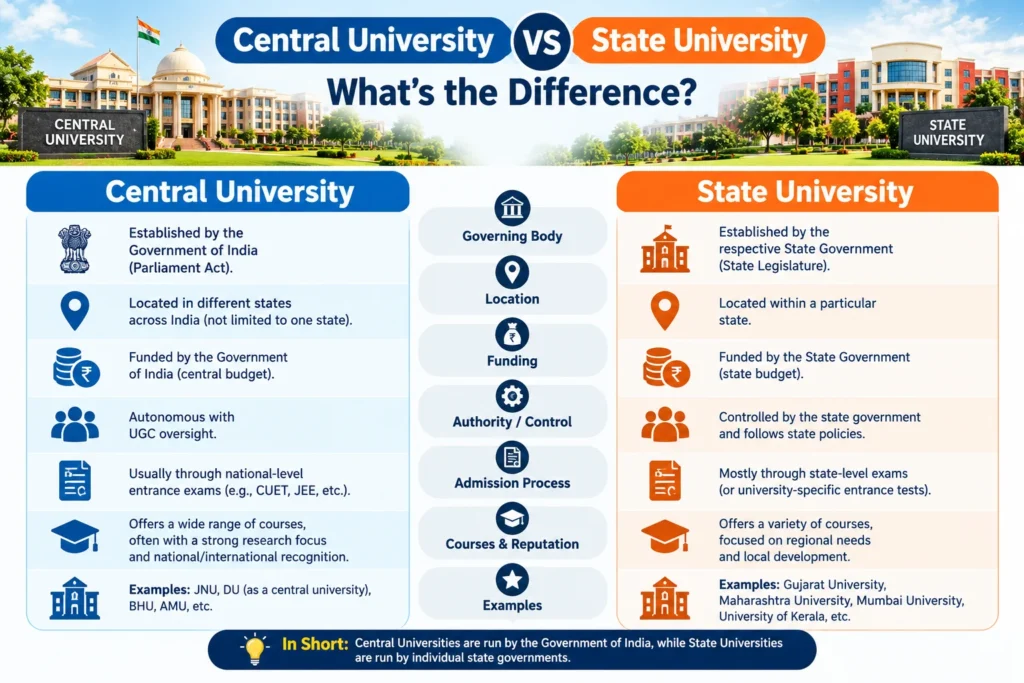
The main difference in central university vs state university comes down to who creates and funds the institution. A central university is set up by an Act of Parliament and funded mostly by the Union government. A state university is set up by a law passed in a state legislature and funded mainly by that state government. This single difference affects admission routes, fees, reservation rules, home state quotas and even how many colleges a university controls.
This guide by Vidya Nirbhar is for Class 12 students choosing where to apply, parents comparing costs, and graduates deciding where to do a master’s degree. We compare the two types point by point, explain how admission usually works in each, look at a real example from Hyderabad, and list the factors that should matter more than the label on the gate. Both types award UGC recognised degrees, so the real question is which one fits your course, budget and location.
Central University vs State University: The Basic Difference
A central university comes into existence through a central law. Examples include the University of Delhi, Banaras Hindu University and the University of Hyderabad. The Ministry of Education oversees them, most receive grants through the University Grants Commission (UGC), and the President of India is their Visitor.
A state university is created by a state Act. Examples include the University of Mumbai, Savitribai Phule Pune University, Osmania University, Anna University and Jadavpur University. The state government provides most of the funding, and the Governor of the state usually serves as Chancellor, although some states have changed this arrangement through their own laws.
According to the UGC’s consolidated list dated January 2023, India had 460 state universities and 56 central universities. You can see the category wise breakdown in the UGC consolidated list of all universities. The number of state universities has grown since then as states continue to set up new ones.
Point by Point Comparison
| Point | Central University | State University |
|---|---|---|
| Created by | Act of Parliament | Act of the state legislature |
| Main funding | Union government, mostly through UGC | State government, with some central support through schemes and UGC grants for eligible universities |
| Head | President of India as Visitor | Usually the Governor as Chancellor, subject to state law |
| Usual UG admission | CUET UG conducted by NTA | Class 12 merit, state entrance tests or CUET, depending on the university |
| Home state quota | Usually none | Common, especially in professional courses |
| Reservation policy | Central reservation rules | State reservation rules, which differ from state to state |
| Affiliated colleges | Most have few or none, DU being a large exception | Many are affiliating universities with dozens or hundreds of colleges |
| Medium and language | Mostly English, with Hindi and others in some places | English and the regional language are both common |
| Fees | Generally low to moderate | Generally low to moderate, varies by state and college type |
These are general patterns. Each university’s Act and admission rules decide the details, so check the official prospectus before you finalise your choice.
How Admission Differs
Admission in central universities
Most central universities admit undergraduate students through CUET UG, conducted by the National Testing Agency. You take one test, then apply on each university’s own portal, such as DU’s Common Seat Allocation System. Postgraduate admissions often use CUET PG, while certain professional programmes use national exams such as JEE Main, NEET or CLAT.
Admission in state universities
State universities follow a wider mix of methods:
- Class 12 merit: Many arts, science and commerce colleges affiliated to state universities admit students on Class 12 marks through a centralised online process.
- State entrance tests: Engineering and pharmacy seats often go through state exams, such as MHT CET in Maharashtra, WBJEE in West Bengal or TS EAPCET in Telangana.
- CUET: A growing number of state universities accept CUET scores for some programmes.
- University entrance tests: Some state universities run their own tests, mainly for postgraduate programmes.
A practical point many students miss is the home state quota. Several state universities and their colleges reserve a large share of seats for students domiciled in that state. If you are applying from outside, your chances may depend on the small number of seats open to all candidates. Central universities generally do not apply such quotas, which makes them more accessible for students who want to study outside their home state.
Fees and Funding
Both central and state universities are publicly funded, so their fees are usually much lower than those at private universities. Even so, the details differ.
Central universities tend to have more stable funding because the Union government finances them. State universities depend on the state budget, so funding can vary considerably between states. Many state universities also run self financing courses, where fees are higher because the programme is not covered by government grants.
In state university systems, fees can also vary between colleges. A government or aided college affiliated to a state university will often charge much less than a self financing college affiliated to the same university, even for the same degree. Always check whether a college is government, aided or self financing before you compare costs. For commerce aspirants, our page on the BCom course shows how the same programme is offered across different universities.
Affiliating vs Unitary Structure
This is one of the less discussed but most important differences. Many state universities are affiliating universities. They frame the syllabus, conduct examinations and award degrees, while teaching happens in affiliated colleges. The University of Mumbai and Savitribai Phule Pune University each have a very large network of affiliated colleges.
Most central universities are unitary or campus based. Teaching happens directly in the university’s own departments. There are exceptions, such as the University of Delhi, which works through a large number of constituent and affiliated colleges.
Why does this matter? In an affiliating system, your actual experience depends heavily on the college you join, not just the university name. Two students with degrees from the same state university may have studied in very different conditions. When comparing options, look at the college’s own faculty, facilities, NAAC grade and results.
Real Example: University of Hyderabad and Osmania University
Hyderabad gives a clear side by side example because it has both a major central university and a major state university.
The University of Hyderabad is a central university established by an Act of Parliament in 1974. It is mainly a campus based university with a strong focus on postgraduate teaching and research, and it offers integrated master’s programmes after Class 12. Admission to many of its programmes is through CUET, and students from across India compete for the same seats under central reservation rules.
Osmania University, founded in 1918, is a state university of Telangana. Alongside its own campus departments, it has a large network of affiliated colleges across the region. Undergraduate admissions in its affiliated degree colleges in Telangana are handled through the state’s centralised online admission system, and engineering seats are filled mainly through the state entrance exam, with state domicile rules applying to most seats.
The lesson here is that the better choice depends on the student. A student from another state looking for a research focused integrated MSc may find the University of Hyderabad more accessible. A student from Telangana wanting a BCom or BSc at a nearby college with low fees may find the Osmania system more practical. Both universities award recognised degrees.
Advantages and Limitations
Central universities
- Advantages: National intake, single entrance through CUET, relatively stable funding, students from many states, and generally good research facilities.
- Limitations: Fewer seats, high competition, admission schedules that sometimes run late, and uneven facilities at some newer campuses.
State universities
- Advantages: Many more seats and colleges, home state quotas that help local students, regional language options, and colleges close to home that reduce living costs.
- Limitations: Quality varies widely between affiliated colleges, funding depends on the state budget, examinations and results can sometimes be delayed, and outside state students may have limited seats.
Rankings show that both types can perform well. In NIRF 2025, released on 4 September 2025, Jadavpur University, a state university, ranked 9th in the university category, ahead of several central universities.
Important Factors to Consider Before Choosing
- The strength of the specific department or college for your subject
- Your eligibility under home state quotas and reservation rules
- Total cost, including hostel, travel and living expenses
- The admission route, and if you have taken the right test for it
- NAAC grade and NIRF rank, if available, of the university or college
- Placement support, internships and alumni links in your field
- Medium of instruction and language comfort
Common mistakes students make
- Choosing a central university only for the label, even when a nearby state college has a stronger department in their subject
- Ignoring state university application deadlines while waiting for CUET results
- Not checking whether a college is government, aided or self financing before comparing fees
- Assuming a state university degree is less valuable for jobs. Both are recognised by UGC.
Conclusion
The difference between a central university and a state university lies mainly in who creates and funds it, which then shapes admission routes, home state quotas, reservation rules and college structure. Central universities offer national intake through CUET, while state universities offer more seats, regional access and home state advantages. Neither is automatically better. Compare the specific department or college, total cost and your eligibility. Vidya Nirbhar creates these guides to help you make that decision with clear facts. You can compare central and state universities across India on VidyaNirbhar before you shortlist your options.
Frequently asked questions
Is a central university degree more valuable than a state university degree?
Not in terms of recognition. Degrees from both central and state universities are recognised by UGC and are valid for government jobs, competitive exams and higher studies in India. Employers usually care more about your skills, subject knowledge and the reputation of your specific department or college than the university type.
Can I join a state university in another state?
Yes, but seats may be limited. Many state universities and their colleges reserve a large share of seats for students domiciled in that state, especially in professional courses. Seats open to all candidates are usually fewer. Read the domicile and eligibility rules in the admission notice before applying.
Do state universities accept CUET scores?
Some do. A growing number of state universities accept CUET UG scores for selected programmes, while others continue to use Class 12 marks or their own entrance tests. Check the list of participating universities in the CUET information bulletin for the current year and the university's own admission notice.
Which is cheaper, a central or a state university?
Both are usually affordable compared with private universities. Within state university systems, government and aided colleges are often the cheapest options, while self financing colleges cost more. Central university fees vary by programme. Compare the official fee notices for the specific course and college for the current academic year.
Are reservation rules the same in central and state universities?
No. Central universities generally follow central government reservation rules for SC, ST, OBC (non creamy layer), EWS and persons with disabilities. State universities follow their own state's reservation policy, and category lists can differ. A category certificate issued for state purposes may not be accepted for central admissions.
Can I switch from a state university to a central university after the first year?
Mid course migration is difficult and depends on both universities' rules and seat availability. Most central universities do not routinely admit students into the second year. A more practical route is to complete your undergraduate degree and apply to a central university for postgraduate study through CUET PG or the university's entrance test.