
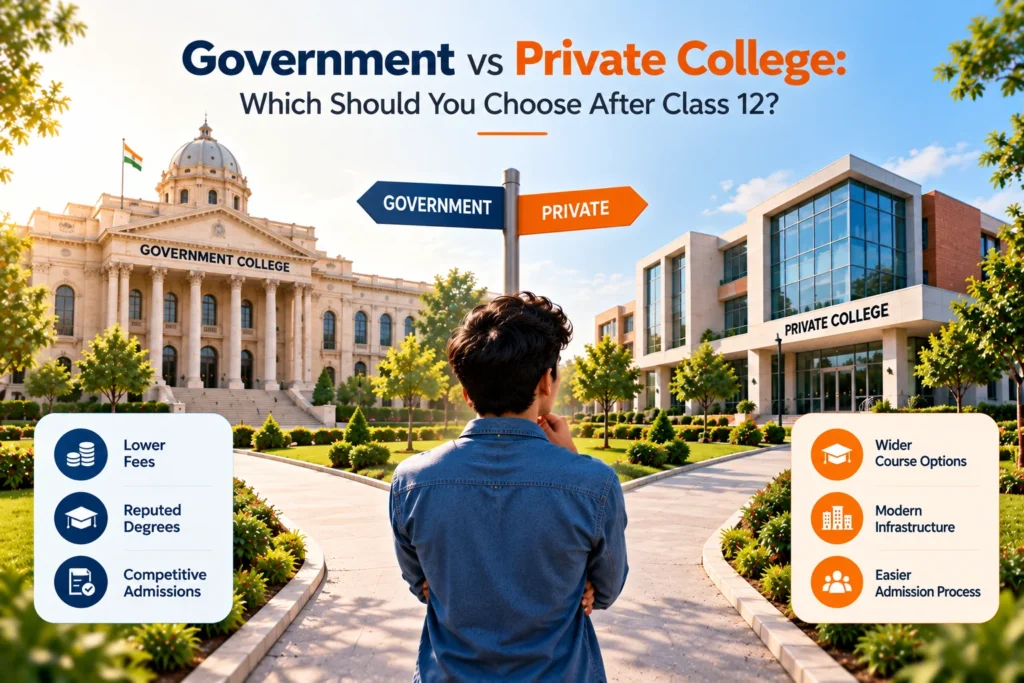
The government vs private college decision is one of the most common dilemmas for Indian families after Class 12. A government college is run and funded by the state, usually charges low fees and admits students through merit or entrance based processes. A private college is managed by a trust, society or company and runs mainly on fees, though some private colleges receive government grants. Both can be affiliated to the same university and lead to the same degree, so the choice depends on far more than the label.
This guide by vidya nirbhar is for Class 12 students, parents comparing costs and anyone helping a student decide. We explain the different kinds of government and private colleges, compare them on fees, admission, faculty, facilities and outcomes, look at real ranking data, and share a practical way to decide. The goal is not to declare one type better, but to help you judge individual colleges fairly.
Government vs Private College: Understanding the Categories
In India, “government” and “private” are not simple opposites. There are at least four types you will come across:
| Type | Management | Funding | Typical Fees |
|---|---|---|---|
| Government college | State government or a government body | Fully government funded | Lowest |
| Government aided (grant in aid) college | Private trust or society | Government pays salaries and some costs | Low to moderate for aided programmes |
| Private unaided (self financing) college | Private trust, society or company | Student fees | Moderate to high |
| Constituent college of a university | University | University and government funds | Usually moderate |
Many aided colleges also run self financing programmes on the same campus, where fees are higher. So the same college can charge very different fees for different courses. Always check the fee for your specific programme.
Key Differences at a Glance
| Point | Government College | Private College |
|---|---|---|
| Fees | Low, often subsidised | Higher, set by management within state or council rules |
| Admission | Merit, centralised state portals or entrance exams | Merit, entrance exams, management quota in some states and courses |
| Faculty | Appointed through government processes, often experienced, sometimes with vacancies | Appointed by management, quality and stability vary |
| Infrastructure | Older campuses common, upgrades depend on grants | Often newer buildings, but varies widely |
| Seats | Limited and competitive | Usually more available |
| Reservation | State reservation rules apply | Applies in many states and courses, varies by state law |
| Accountability | Covered by RTI and public audit | Regulated by university, state and councils, less public scrutiny |
Fees: The Biggest Difference
For most families, fees decide the matter. Government colleges are subsidised, so tuition is usually a small fraction of what self financing private colleges charge. Many states also offer fee reimbursement or free education schemes for eligible categories in government and aided colleges.
Private college fees are often regulated for professional courses. Several states have fee regulatory committees that fix or approve fees for private professional colleges, such as engineering, pharmacy and medical colleges. For general degrees in self financing colleges, fees are set by management within university and state rules. Always use the official fee notice for the current academic year and add hostel, transport and exam costs.
Admission: How Seats Are Filled
Government and aided colleges usually fill seats through centralised state admission portals or university merit lists based on Class 12 marks, or through entrance exams for professional courses. Gujarat’s GCAS portal, for example, covers government, grant in aid and self financed colleges of its state universities through one application.
Private colleges may take part in the same state process for some seats and fill others directly. In certain states and courses, a portion of seats in private professional colleges is filled under a management or NRI quota at higher fees, subject to state rules. If you are offered such a seat, read the fee and refund terms carefully.
Faculty and Teaching
Government colleges often have permanent teachers appointed through formal recruitment, with job security and experience. However, many states have reported faculty vacancies in government colleges, which can mean larger classes or reliance on guest lecturers.
Private colleges vary widely. Some recruit qualified faculty and invest in training. Others rely on young, low paid or temporary staff with high turnover. When comparing, ask how many permanent teachers teach your subject and how long they have been with the college.
Infrastructure and Facilities
Private colleges often advertise modern buildings, air conditioned classrooms and smart boards. These help, but they do not guarantee good teaching. Government colleges may have older buildings but can have large libraries, established labs and spacious campuses. For science and computer courses, check lab equipment and hours. For all courses, check library resources, internet access and study spaces.
What Rankings Show
Ranking data shows that strong colleges exist across management types. In NIRF 2025, released by the Ministry of Education on 4 September 2025, the top ten colleges included Hindu College, Miranda House, Hans Raj College and Kirori Mal College of the University of Delhi, along with privately managed colleges such as St. Xavier’s College Kolkata, PSGR Krishnammal College for Women and PSG College of Arts and Science in Coimbatore. You can view the full list and each college’s data on the NIRF website.
The lesson is that management type alone does not decide quality. What matters is how well a particular college is run.
Real Example: PSG College of Arts and Science, Coimbatore
PSG College of Arts and Science in Coimbatore shows how a privately managed college can work within the public system. It is run by a private trust, is affiliated to Bharathiar University, a state university, and functions as an autonomous college. In NIRF 2025, it ranked 10th in the college category.
Colleges like this often run a mix of aided and self financing programmes. Fees for aided programmes tend to be lower, while self financing programmes cost more. A student considering such a college should check which category their programme falls under, compare its fee with nearby government colleges, and look at faculty, results and outcomes for that specific department.
The practical lesson is that “private” does not always mean expensive or unregulated, and “government” does not always mean better. Examine the specific college and programme before deciding.
Advantages and Limitations
Government colleges
- Advantages: Low fees, fee reimbursement schemes, experienced permanent faculty, public accountability and long track records.
- Limitations: Limited seats, high cut offs, possible faculty vacancies, older infrastructure and slower administrative processes.
Private colleges
- Advantages: More seats, often newer facilities, sometimes stronger industry links and student services, and flexible add on courses.
- Limitations: Higher fees, quality that varies sharply, possible faculty turnover and less public scrutiny.
Scholarships and Financial Support in Both Types
Financial help is available whichever type you choose. The Central Sector Scheme of Scholarship for College and University Students, applied for through the National Scholarship Portal, supports students who scored in the 80th percentile or above in Class 12 in their board and stream, with family income below ₹4.5 lakh a year. It pays ₹12,000 a year for the first three years of undergraduate study and ₹20,000 a year beyond that or for professional courses, for regular courses at recognised institutions.
For loans, the PM-Vidyalaxmi scheme approved by the Union Cabinet in November 2024 offers collateral free, guarantor free education loans for students admitted to around 860 quality institutions identified through NIRF, with a 3 percent interest subvention for families earning up to ₹8 lakh a year on loans up to ₹10 lakh. State scholarships and college level concessions add further options.
Questions to Ask Before Paying a Private College
- Is my programme aided or self financing, and what is the total fee for all years?
- Is this seat through the state process or a management quota?
- What is the refund policy if I get a government seat later?
- How many permanent teachers teach my subject?
- Can I see the affiliation letter and NAAC certificate?
Write down the answers and compare them with at least one government or aided option before you pay anything.
Important Factors to Consider
- Affiliation to a recognised university for your course and year
- Council approval for professional courses, such as AICTE, PCI, NCTE or INC
- The college’s own NAAC accreditation and its validity
- Number and qualifications of permanent faculty in your subject
- Full programme cost and available scholarships
- Results, higher study progression and placement data
- Distance from home, hostel availability and safety
If you are planning a commerce degree, our page on the BCom course shows colleges of different types offering it.
A Simple Way to Decide
- List government and aided colleges offering your course where you are likely to get admission.
- List private colleges offering the same course.
- Remove any college without clear affiliation or approvals.
- Compare the rest on faculty, NAAC status, results, full cost and outcomes.
- If a government or aided college is close in quality, the lower cost usually makes it the sensible choice.
- Choose a private college if it is clearly stronger for your course, or if you cannot get a seat in a good government option, and the cost is manageable.
Common mistakes
- Assuming all government colleges are better than all private colleges, or the reverse
- Comparing fees without checking whether a programme is aided or self financing
- Paying for a management quota seat before state counselling results are out
- Judging a college by its building instead of its teachers and results
Conclusion
In the government vs private college comparison, government and aided colleges usually win on cost and public accountability, while good private colleges can offer more seats, newer facilities and stronger student services. Ranking data shows quality exists in both types, so judge each college on affiliation, faculty, results, total cost and outcomes. Vidya nirbhar prepares these guides to help families choose with clear facts. You can compare government and private colleges across India on VidyaNirbhar before making your decision.
Frequently asked questions
Is a government college degree more valuable than a private college degree?
No. If both colleges are affiliated to the same recognised university, the degree is awarded by that university and carries the same value. Employers and universities look at your marks, skills and the reputation of your specific college and programme rather than whether it is government or private.
Are private colleges always more expensive?
Usually, but not always. Aided programmes in privately managed colleges can have fees close to government colleges. Self financing programmes cost more. Some private colleges also offer scholarships. Compare the full fee for your programme using official notices.
What is a grant in aid college?
A grant in aid college is managed by a private trust or society but receives government grants, usually for teacher salaries. Fees for aided programmes are regulated and generally low. The same college may also run self financing programmes with higher fees.
Do private colleges follow reservation rules?
In many states, private colleges must follow state reservation policies for seats filled through centralised admission, especially in aided programmes. Rules for self financing and management quota seats vary by state and course. Check the state admission rules and the college prospectus.
How can I check if a private college is genuine?
Confirm affiliation on the university's official list of colleges, check the AISHE portal, verify council approval for professional courses and look up the college's NAAC status. Avoid colleges that cannot show affiliation letters or that ask for fees in cash.
Is campus placement better in private colleges?
Not necessarily. Some private colleges have active placement cells, while many government colleges have strong alumni networks and good progression to higher studies. Ask for programme specific data on the number placed and median salary, and compare like with like.