
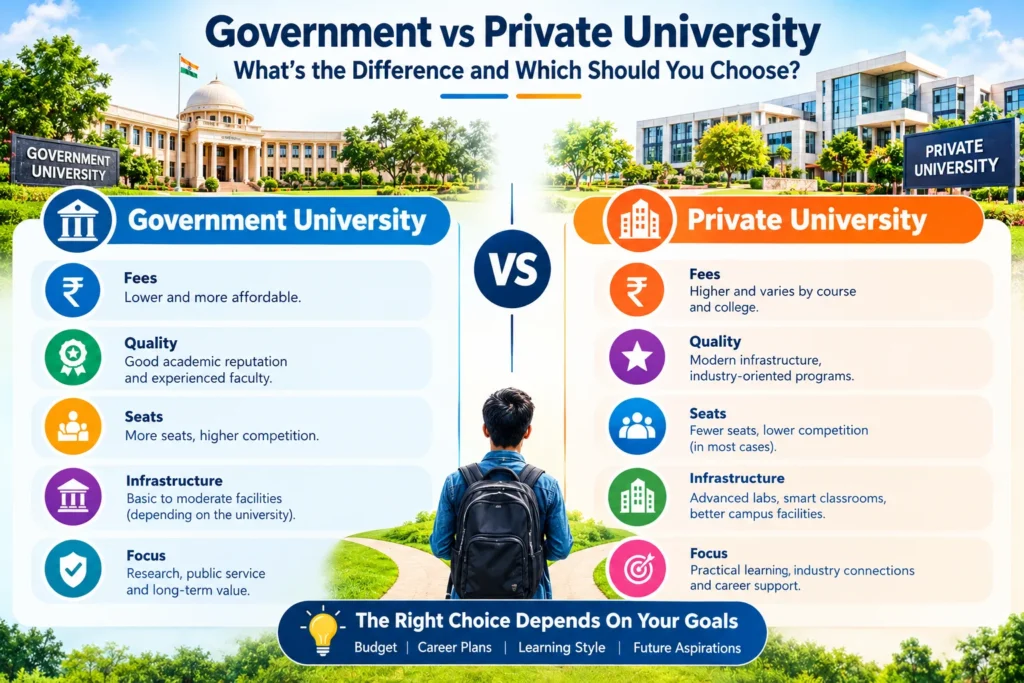
The government vs private university question is one of the first decisions Indian families face after Class 12. In simple terms, a government university is created and funded by the Union or a state government, while a private university is set up by a trust, society or company under a state law and runs mainly on student fees. Both can award valid, UGC recognised degrees, but they differ a lot in fees, admission routes, seat availability, flexibility and accountability.
This guide by Vidya Nirbhar is for Class 12 students, parents planning the budget, and graduates comparing postgraduate options. We explain what each type is, how to tell them apart, where each one does better, how to check a private university’s legitimacy, and what questions to ask before paying any fee. The aim is not to declare a winner, because the right choice depends on the specific institution, course and your circumstances.
Government vs Private University: Basic Meaning
Government universities include central universities, created by Acts of Parliament, and state universities, created by state legislatures. Examples are the University of Delhi, Banaras Hindu University, the University of Mumbai and Gujarat University. Some deemed to be universities, such as the Indian Institute of Science, are also publicly funded.
Private universities in the strict sense are state private universities. Each one is created by a separate state Act or under a state’s private universities law, on the application of a sponsoring body. Examples include Ashoka University in Haryana, Nirma University in Gujarat and Lovely Professional University in Punjab. Many private deemed to be universities, such as BITS Pilani and Manipal Academy of Higher Education, are also privately managed, though their legal category is different.
According to UGC data from late 2023, India had 455 private universities, compared with 478 state universities and 56 central universities. The private sector has grown faster than any other category over the last two decades.
Key Differences at a Glance
| Point | Government University | Private University |
|---|---|---|
| Set up by | Parliament or a state legislature | A sponsoring trust, society or company under a state Act |
| Main funding | Government grants | Student fees and sponsoring body |
| Fees | Generally low to moderate | Generally higher, sometimes several times higher |
| Admission | CUET, state entrance tests or merit lists | Own entrance tests, interviews, merit or national exams |
| Seats | Limited and highly competitive in popular courses | Often more seats and multiple intake rounds |
| Affiliated colleges | Many state universities affiliate colleges | Cannot affiliate colleges. Teaching happens on their own campus. |
| Reservation | Central or state reservation rules apply | Varies by state law. Some states mandate quotas, others do not. |
| Curriculum changes | Slower, through statutory bodies | Often quicker to add new programmes and electives |
How to Tell If a University Is Government or Private
Names can be misleading. A private university may use words like “Central”, “National” or “Indian”, and some government institutions have names that sound private. Use these checks instead:
- Look up the university on the UGC website, which publishes separate lists of central, state, private and deemed to be universities.
- Read the “About” page on the official website for the Act under which it was set up. A state private universities Act or a sponsoring body’s name indicates a private university.
- Check the fee structure. Very high tuition with no government grant mention usually points to a private or self financing setup.
- Confirm with the state higher education department website, which often lists universities by type.
The UGC state wise list of private universities is the most direct way to confirm whether a private university is recognised.
Where Government Universities Do Better
Lower fees
Because government grants cover much of the cost, tuition is usually far lower than at private universities. For families on a tight budget, this is often the deciding factor. Keep in mind that self financing programmes inside government universities can cost more than regular programmes.
Long track record and wide acceptance
Many government universities have decades of history, large alumni networks and research output. In NIRF 2025, government institutions such as IISc, JNU, Jamia Millia Islamia, the University of Delhi, BHU, Jadavpur University and AMU appeared in the top ten of the university category.
Public accountability
Government universities answer to state legislatures or Parliament, follow reservation policies and come under the Right to Information Act. This adds transparency to admissions, fees and appointments.
Where Private Universities Can Do Better
Flexibility and newer programmes
Private universities can often introduce new programmes, such as data science, design or liberal arts with flexible majors, faster than government universities. They may also offer more electives, foreign language options and international tie ups.
Seat availability and admission timelines
Private universities usually have more seats and run admissions early, sometimes before CUET results. This can give students a backup option. For courses like a BBA or BTech, they may admit through their own test or national exam scores.
Infrastructure and student services
Well funded private universities may have newer buildings, smaller classes and dedicated placement teams. This is not universal, though. Facilities vary sharply between private universities, and a large campus does not guarantee good teaching.
Several private institutions also do well in rankings. In NIRF 2025, Manipal Academy of Higher Education (3), BITS Pilani (7) and Amrita Vishwa Vidyapeetham (8), all privately managed deemed to be universities, were in the top ten universities.
Real Example: Ashoka University and the Haryana Private Universities Act
Ashoka University in Sonipat, Haryana, is a useful example of how a state private university works. It was established in 2014 under Haryana’s private universities law and is run on a not for profit basis by its founders and donors. It focuses on liberal arts and sciences.
Ashoka uses its own admission process instead of CUET. According to the university, this includes an application with essays, its own aptitude assessment and an interview. Fees are much higher than at government universities, and the university states that it offers need based financial aid to eligible students. Families should read the current fee and aid details on its official admissions page, since these change each year.
The lesson for students is that a private university’s value depends on its specific teaching, faculty and outcomes, not on being private. Ashoka shows that private universities can build strong academic programmes. Many others, however, have weak faculty or poor outcomes, so each one needs individual checking.
Risks with Private Universities and How to Avoid Them
India has seen what happens when private universities are set up without proper checks. In 2005, in Prof. Yashpal and Another vs State of Chhattisgarh, the Supreme Court struck down provisions of a Chhattisgarh law under which many private universities had been notified without adequate infrastructure. Students enrolled in those institutions faced serious uncertainty.
To protect yourself:
- Confirm the university is on the UGC list of private universities.
- Check that the programme has the required approval from councils such as AICTE, BCI, NCTE, PCI or NMC, where applicable.
- Remember that private universities generally cannot run study centres or campuses outside their state without permission. Be cautious about “branch campuses” in other states.
- For online or distance degrees, check the UGC Distance Education Bureau’s list of entitled institutions for your admission year.
- Ask for the NAAC grade, recent placement report and faculty details, and verify them where possible.
- Read refund rules before paying. UGC has issued guidelines on fee refunds when students withdraw.
Which Should You Choose? Three Practical Scenarios
Scenario 1: Tight budget, good CUET or state exam score. A government university or a government aided college is usually the sensible first choice. The fee difference over three or four years can be large, and recognition is not an issue.
Scenario 2: Specific programme not offered nearby. If you want a niche programme, such as design or a particular specialisation, and no government university near you offers it, a recognised private university with proper approvals can be a reasonable option. Compare at least two or three such universities before deciding.
Scenario 3: Missed government admission cut offs. Instead of rushing into the first private offer, look at state universities and their affiliated colleges, which often run later admission rounds. In Gujarat, for example, Gujarat University and its colleges admit students through state processes that may still have seats after national counselling ends. Then compare those options with private universities on cost and quality.
Important Factors to Consider Before Choosing
- Total cost: Add tuition, hostel, mess, transport and exam fees for the full course, not just the first year.
- Department strength: Compare faculty qualifications, labs and the curriculum for your specific subject.
- Recognition and approvals: Confirm UGC status and any professional council approval.
- Outcomes: Look at verified placement data, higher study admissions and alumni careers.
- Scholarships: Many private universities offer merit or need based concessions. Government universities offer low fees plus state and central scholarships.
- Location: Living costs in big cities can outweigh tuition savings.
Common mistakes
- Judging a university only by campus photos or advertisements
- Accepting placement claims without asking for the number of students placed and the median package
- Paying a large non refundable seat booking fee before government admission results are out
- Assuming all government colleges are equal. Quality varies widely there too.
Conclusion
In the government vs private university comparison, government universities usually win on fees, track record and public accountability, while good private universities can offer flexibility, newer programmes and more seats. Neither type is right for everyone. Check recognition on the UGC list, confirm council approvals, compare total costs and ask for verified outcomes before you decide. Vidya Nirbhar puts together these guides to help families make informed choices. You can compare government and private universities across India on VidyaNirbhar and shortlist options that match your course and budget.
Frequently asked questions
Is a private university degree valid for government jobs?
Yes, if the university is recognised by UGC and the programme has any required council approval. Degrees from recognised private universities are valid for government jobs, competitive exams and higher studies. Always confirm recognition for your admission year, especially for online, distance or professional programmes.
Are private universities more expensive than government universities?
Generally, yes. Private universities depend mainly on student fees, so tuition is usually higher, sometimes several times higher than at government universities. Some private universities offer scholarships or need based aid that reduce costs. Compare total course costs from official fee notices for the current academic year.
Do private universities follow reservation rules?
It depends on the state law under which the university was set up. Some states require private universities to reserve seats for certain categories or for domicile students, while others do not. Government universities follow central or state reservation policies. Check the admission brochure for the specific rules.
Can a private university open campuses in other states?
Generally, no. A state private university is meant to operate within the state that created it, and off campus centres need approval under UGC rules. Be cautious of private universities advertising campuses or study centres in other states. Verify any such campus on the UGC website before enrolling.
Are placements better at private universities?
Not necessarily. Some private universities have active placement cells, but outcomes vary widely. Many government universities also have strong placement records in certain departments. Ask for verified data, including how many students were placed, median salary and the list of recruiters, instead of relying on the highest package figure.
Is a deemed university the same as a private university?
No. A deemed to be university gets its status from the Central Government under Section 3 of the UGC Act, while a state private university is created by a state law. Many deemed universities are privately managed, but some, like IISc, are government funded. Their rules on campuses and programmes also differ.