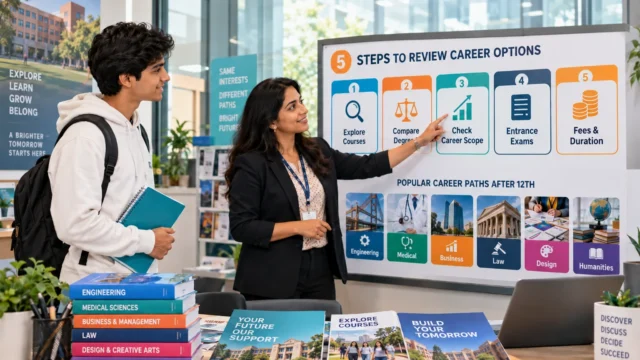

Distance education is a way of studying where the learner and the teacher are not in the same place for most of the course. Instead of attending daily classes, students learn from study material, recorded or live online sessions and occasional contact classes, and then appear for examinations. If you are asking what is distance education in India, it is the system officially called Open and Distance Learning (ODL), regulated by the University Grants Commission (UGC) through its Distance Education Bureau.
This guide by Vidya Nirbhar is for working professionals, students who could not get a regular seat, homemakers, people in remote areas and parents comparing study options. We explain how distance education works, the different types of institutions that offer it, what the UGC rules say, which courses are allowed, how it compares with regular and online education, and how to check whether a programme is valid before you pay any fee.
What Is Distance Education? A Clear Definition
In distance education, learning happens mostly outside a classroom. The institution provides structured self learning material and support, and the student studies at their own pace within a set time frame. Assessment usually includes assignments and term end examinations held at approved centres.
India has a long history with this model. The University of Delhi started correspondence courses in 1962 through its School of Correspondence Courses and Continuing Education, now known as the School of Open Learning. Over the decades, correspondence education grew into the broader ODL system, supported by open universities and distance education directorates at regular universities.
Today, the governing framework is the UGC (Open and Distance Learning Programmes and Online Programmes) Regulations, 2020. These rules cover which institutions can offer ODL, which programmes are allowed, minimum standards for study material and learner support, and the territorial limits within which institutions can operate.
How Distance Education Works
- Enrolment: Students apply online, usually without an entrance test for most programmes, and pay fees directly to the university.
- Study material: The university sends or uploads self learning material written for independent study. Many institutions now provide e-content and video lectures.
- Learner support centres: These centres, run or approved by the university, hold counselling sessions and practicals where needed.
- Assignments: Students submit assignments that count towards internal assessment.
- Examinations: Term end exams are conducted by the university at designated exam centres, usually twice a year.
- Results and degree: The degree is issued by the university, just as for regular students, with the mode noted as per university practice.
Types of Institutions Offering Distance Education
Open universities
These universities exist mainly to teach through ODL. IGNOU is the national open university created by Parliament in 1985, and many states have their own state open universities, such as Yashwantrao Chavan Maharashtra Open University and Netaji Subhas Open University.
Dual mode universities
Many regular universities run a separate centre or directorate for distance education alongside their campus programmes. These are often called a Centre for Distance and Online Education or Directorate of Distance Education. For example, Annamalai University in Tamil Nadu has long offered distance programmes alongside its regular teaching.
Online programme providers
Under the 2020 regulations, eligible universities can also offer fully online degree programmes. These differ from traditional ODL because teaching, assessment and even examinations happen online, often with proctored tests. Only institutions that meet UGC criteria and appear on the Distance Education Bureau list can offer them.
Distance Education vs Regular vs Online Education
| Point | Distance (ODL) | Online | Regular |
|---|---|---|---|
| Classes | Self study with occasional contact sessions | Online lectures and digital content | Daily classes on campus |
| Exams | At physical exam centres | Often online and proctored | On campus |
| Entry | Usually no entrance test | Usually no entrance test | CUET, entrance exams or merit |
| Fees | Usually low | Low to moderate | Varies widely |
| Recognition needed | UGC DEB recognition for the session | UGC DEB entitlement or recognition for the session | UGC recognition and council approvals |
| Campus life and placements | Very limited | Limited | Full |
Courses Allowed and Not Allowed in Distance Mode
Distance education is common for BA, BCom, MA, MCom, BBA, MBA, BCA, MCA, library science and a range of diplomas and certificates. Commerce learners often consider a distance BCom while working.
However, according to the UGC Distance Education Bureau, programmes in engineering, medical, physiotherapy, occupational therapy, paramedical disciplines, pharmacy, nursing, dental, architecture, law, agriculture, horticulture, hotel management, catering technology, culinary sciences, aircraft maintenance, visual arts and sports cannot be offered through ODL or online mode. MPhil and PhD are also excluded. The full list and explanations are on the UGC DEB frequently asked questions page.
In August 2025, the UGC added another restriction. From the July 2025 session, it stopped ODL and online admissions in programmes covered by the National Commission for Allied and Healthcare Professions Act, 2021. News reports listed psychology, microbiology, food and nutrition science, biotechnology and clinical nutrition and dietetics among the affected programmes.
Is Distance Education Valid in India?
Yes, when the university and the specific programme are recognised by UGC for the year of admission. Regulation 22 of the 2020 regulations says that degrees, diplomas and certificates awarded through ODL or online mode by recognised institutions shall be treated as equivalent to the corresponding awards through conventional mode.
Three conditions matter:
- Recognition for your session: UGC grants recognition programme wise and year wise. Check the list for the session in which you enrol.
- Territorial jurisdiction: State universities and private universities can generally offer ODL only within their own state, through approved centres. A central university’s jurisdiction depends on its Act.
- No franchising: UGC does not allow universities to offer ODL programmes through franchise arrangements. Avoid “study centres” run by agents in other states.
Distance degrees from recognised programmes are generally accepted for government jobs, competitive exams and higher studies. Some recruitment rules or professional bodies may have their own conditions, so read job notifications carefully.
Real Example: Delhi University’s School of Open Learning
The School of Open Learning (SOL) at the University of Delhi is one of India’s oldest distance education units. It began in 1962 as the School of Correspondence Courses and Continuing Education and later took its current name. It is part of a regular central university, which makes it a good example of the dual mode model.
SOL offers undergraduate and postgraduate programmes, mainly in arts, humanities and commerce, including BA Programme, BCom Programme and several honours courses, along with programmes such as BMS and library science. It works through regional centres in Delhi that handle student support and contact classes. Students receive study material, attend weekend or scheduled sessions where offered, and appear for university examinations.
Because SOL is part of DU, its degrees are issued by the University of Delhi. The practical lesson is that distance education from an established university can give learners a recognised degree at a lower cost than regular college. At the same time, students must plan their own study time and should check the current year’s programme list and fee notice, since offerings change with UGC rules.
Fees and Financial Support
Distance programmes usually cost much less than regular programmes because there are no daily classes, hostels or large campus overheads. Fees are generally charged per year or per semester, with separate charges for registration, examinations and sometimes study material. Exact amounts differ by university and programme and are published in each year’s prospectus.
Some open universities offer fee waivers for SC and ST learners, persons with disabilities or other groups under state or central schemes. Working learners can sometimes claim employer sponsorship. Professional programmes such as a distance MBA generally cost more than BA or BCom, so compare total fees for the full duration.
Who Should Choose Distance Education?
Distance learning is a good fit for people who already work and need a degree for promotion or a government exam, students who could not get a regular seat but want to continue studying, and learners who live far from a good college. It is less suitable for students who want campus placements, lab based science or close mentoring from teachers.
Advantages and Limitations of Distance Education
Advantages
- Study while working, caring for family or preparing for competitive exams
- Lower fees and no relocation costs
- Usually no entrance test and no upper age limit
- Recognised degrees when UGC conditions are met
Limitations
- Limited teacher contact and peer learning
- Little or no campus placement support
- Not available for professional and many science programmes
- High dropout risk without strong self discipline
- Recognition must be checked for each session
How to Choose a Distance Education Programme
- Confirm the university and programme on the UGC DEB list for your admission session.
- Check that you are within the university’s territorial jurisdiction.
- Read the prospectus for eligibility, duration, maximum time allowed and fee schedule.
- Find out where your learner support centre and exam centre will be.
- Look at the quality of study material and online support. Ask current learners if possible.
- Pay fees only on the university’s official portal, never to an agent’s bank account.
Common mistakes to avoid
- Believing promises of a degree “in one year” or “without exams”
- Joining a university from another state through a private centre that is not approved
- Assuming last year’s recognition applies this year
- Enrolling in a programme UGC does not allow in distance mode
Conclusion
Distance education in India, formally known as Open and Distance Learning, lets students earn recognised degrees without attending daily classes. It suits working learners and those who need flexibility, but it is not available for professional courses and demands self discipline. Before enrolling, check UGC DEB recognition for your session, confirm territorial jurisdiction and avoid agents and franchise centres. Vidya Nirbhar prepares these guides so learners can make safe, informed choices. You can compare universities offering distance and regular programmes on VidyaNirbhar and pick the option that fits your goals.
Frequently asked questions
Is distance education the same as online education?
Not exactly. Distance education (ODL) relies mainly on self learning material, contact sessions and exams at physical centres. Online programmes deliver teaching and often examinations through the internet. Both are covered by the UGC 2020 regulations, and both need UGC recognition for the session to be valid.
Can I get a government job with a distance degree?
Generally, yes. Degrees from UGC recognised ODL programmes are treated as equivalent to regular degrees and are accepted for most government jobs and competitive exams. Check the specific recruitment rules for any post, since some technical or professional positions may require a degree in regular mode or council registration.
What is the minimum qualification for distance education?
For undergraduate programmes, the usual requirement is Class 12 or equivalent from a recognised board. Postgraduate programmes need a relevant bachelor's degree. Certificate programmes may accept Class 10 or Class 12. Exact eligibility differs by university and programme, so read the current prospectus.
How long does a distance degree take?
The minimum duration is usually the same as a regular programme, such as three years for BA or BCom and two years for MA or MBA. Most universities allow extra time, often up to double the minimum period, to complete the programme. Check the maximum duration rule in the prospectus.
Can I study in a distance programme from a university in another state?
It depends on the university type. State and private universities can generally offer ODL only within their own state. Central universities like IGNOU can enrol learners across India. Always verify the university's territorial jurisdiction on the UGC DEB website before enrolling.
Is attendance compulsory in distance education?
Daily attendance is not required. However, some programmes have compulsory practical sessions, workshops or a minimum number of counselling sessions, especially where lab work or field work is involved. Assignments must also be submitted on time to appear for exams. Read your programme guide for specific requirements.